How Advertising Agencies in Navi Mumbai Help Businesses Reach More Customers
Advertising today spans far more than a single print ad or a billboard — it’s a coordinated mix of digital campaigns, creative strategy, and media planning working together. For businesses in Navi Mumbai trying to stand out in an increasingly crowded market, attempting this without dedicated expertise often means wasted spend and inconsistent results. A professional advertising agency brings the strategic and creative discipline needed to make every rupee of ad spend work harder.
What Do Advertising Agencies in Navi Mumbai Do?
Building Brand Visibility Through Strategic Advertising
Advertising agencies don’t just place ads — they build a coherent strategy for where, when, and how your brand shows up to maximize recall and recognition.
Creating Integrated Online and Offline Campaigns
The best campaigns often combine digital advertising with offline elements — local events, print, or outdoor media — reinforcing the same message across multiple touchpoints.
Managing End-to-End Advertising Campaigns
From initial creative concept through media buying, execution, and performance reporting, a full-service agency manages the entire process rather than handing off pieces to disconnected vendors.
Services Offered by Advertising Agencies in Navi Mumbai
Digital Advertising Services for Business Growth
Google Ads, social media advertising, and programmatic display campaigns designed around specific business objectives.
Branding and Creative Campaign Development
Developing the core creative concepts, messaging, and visual identity that anchor every campaign.
Social Media and Performance Advertising
Targeted campaigns on Instagram, Facebook, and LinkedIn designed to generate measurable engagement and leads.
Google Ads and Search Engine Marketing
Capturing high-intent search traffic through professionally managed paid search campaigns.
Display Advertising and Remarketing Campaigns
Visual ad placements across the web that keep your brand in front of potential customers, including those who’ve already visited your site.
Media Planning and Media Buying Services
Strategic decisions about where advertising budget is spent for maximum reach and relevance to your specific target audience.
How an Advertising Agency Helps Your Business Grow
Reaching the Right Audience with Data-Driven Campaigns
Advertising decisions grounded in actual audience data and behavior, rather than assumptions about who your customer is.
Increasing Brand Recognition Across Multiple Platforms
Consistent presence across the channels your customers actually use builds recognition and trust over time.
Generating More Qualified Leads and Sales
Ultimately, effective advertising should translate into measurable business outcomes, not just impressions or reach.
Optimising Advertising Spend for Better ROI
Continuous campaign refinement based on performance data ensures budget flows toward what’s actually working.
Advertising Agency vs Digital Marketing Agency – What’s the Difference?
Core Services Offered by Each
An advertising agency typically focuses more heavily on paid campaigns, creative development, and media buying. A digital marketing agency often has a broader scope, including SEO, content marketing, and organic social media alongside paid advertising.
Which One Is Better for Your Business Goals?
If your primary need is high-impact paid campaigns and brand creative, an advertising agency may be the sharper fit. If you need a coordinated mix of organic and paid growth strategies, a full-service digital marketing agency often delivers more integrated value.
When Should You Hire a Full-Service Marketing Agency?
When your business needs both immediate visibility through advertising and sustainable long-term growth through SEO and content — a full-service agency avoids the coordination gaps that come from managing separate vendors for each.
Industries That Benefit Most from Advertising Agencies
Healthcare and Hospitals
Building trust and awareness through consistent, professional advertising across digital and local channels.
Real Estate Developers
High-value purchases that benefit significantly from strong creative campaigns and strategic media placement.
Retail and E-commerce Brands
Directly reliant on advertising to drive both awareness and immediate sales.
Manufacturing and Industrial Businesses
Increasingly using targeted digital advertising for B2B lead generation, despite longer sales cycles.
Educational Institutions and Professional Services
Building credibility and awareness within specific, often local, target audiences.
How to Choose an Advertising Agency in Navi Mumbai
Evaluate Industry Experience and Portfolio
Review whether the agency has genuine experience relevant to your specific business type and scale.
Review Creative Work and Campaign Results
Ask to see actual campaign examples alongside the results they generated, not just polished creative samples.
Understand Their Media Planning Process
A credible agency can clearly explain how they decide where and how to allocate advertising budget.
Compare Pricing, Communication and Reporting
Ensure clarity on costs, communication cadence, and what reporting you’ll receive throughout the engagement.
What Makes the Best Advertising Agency in Navi Mumbai?
Strong Creative Team and Brand Strategy
Advertising that stands out requires genuine creative talent, not just media placement expertise.
Expertise in Performance Marketing and Analytics
The ability to translate creative campaigns into measurable, trackable business results.
Transparent Reporting and ROI Measurement
Clear visibility into how advertising spend is translating into actual business outcomes.
Dedicated Account Management and Client Support
Consistent, responsive points of contact throughout the campaign lifecycle.
Common Mistakes Businesses Make When Hiring an Advertising Agency
Choosing an agency based purely on lowest cost, failing to clearly define campaign objectives upfront, not setting up proper conversion tracking before launching campaigns, and abandoning campaigns too early before sufficient data has been gathered to optimize effectively.
Questions to Ask Before Partnering with an Advertising Agency
What Advertising Channels Do You Specialise In?
Understand whether their expertise genuinely covers the channels most relevant to your business and audience.
How Do You Measure Campaign Success?
Clarify what metrics they’ll track and how those connect to your actual business goals.
Can You Share Relevant Case Studies?
Request examples from businesses of similar size or industry, not just their most impressive unrelated work.
How Often Will Performance Reports Be Shared?
Establish a clear reporting cadence and format before campaigns begin.
Why Choose Our Advertising Agency in Navi Mumbai
Customized Advertising Strategies for Every Business
We build campaigns around your specific goals and audience, not a generic template applied across every client.
Creative Campaigns Backed by Performance Data
Strong creative work paired with rigorous performance tracking and optimization.
End-to-End Advertising and Branding Solutions
From strategy and creative development through execution and reporting, managed by one accountable team.
Experienced Team Across Digital, Print and Media Buying
Comprehensive expertise spanning both digital-first and traditional advertising channels where relevant.
Conclusion
A strong advertising agency does more than place ads — it builds a coherent strategy connecting creative, media planning, and performance data into campaigns that genuinely move your business forward. For Navi Mumbai businesses navigating an increasingly competitive market, partnering with an agency that understands both the local landscape and modern advertising channels is one of the most effective ways to reach more customers efficiently.
Frequently Asked Questions
The right agency depends on your specific industry and campaign goals — prioritize agencies with demonstrated creative and performance results relevant to your business type.
Core services typically include digital advertising, creative and brand campaign development, social media advertising, search engine marketing, display advertising, and media planning and buying.
Costs vary significantly based on scope and ad spend involved — agency management fees commonly range from ₹15,000-50,000+/month, separate from the actual advertising budget itself.
Yes, particularly for businesses that lack in-house creative or media buying expertise — a good agency can significantly improve advertising efficiency compared to a self-managed approach.
Yes, and this integrated approach often produces more consistent, effective results than managing these functions through separate, disconnected vendors.

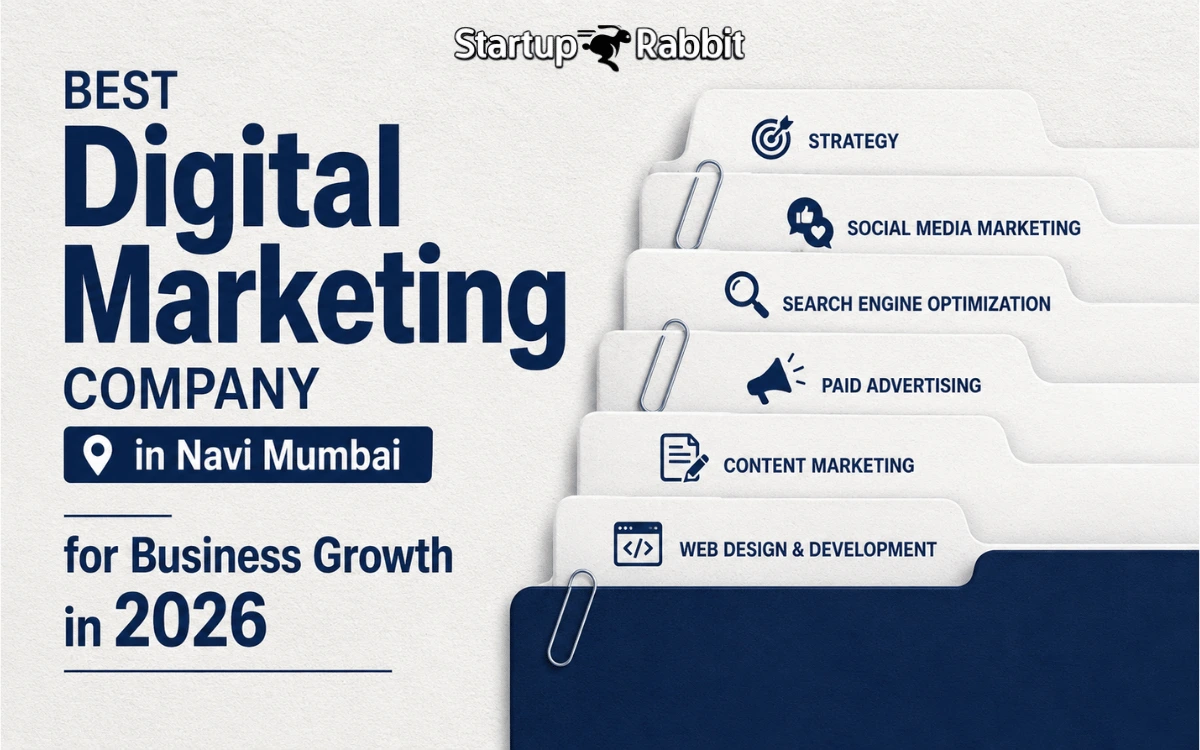
Best Digital Marketing Company in Navi Mumbai for Business Growth
Navi Mumbai has changed a lot in the last few years – healthcare, real estate, manufacturing, IT, retail, all of it growing fast. What’s changed alongside it is where customers actually go to find a business. Walk-ins and word-of-mouth haven’t disappeared, but they’re no longer the primary route. Increasingly, the businesses winning new customers are the ones showing up first on Google, running ad campaigns that actually target the right person, and maintaining a presence people trust before they ever pick up the phone.
The scale of that shift is bigger than most business owners realize. India’s total advertising economy is projected to cross ₹2 lakh crore in 2026, and for the first time, digital now accounts for the majority share of it – industry estimates from the Pitch Madison Advertising Report and WPP Media’s TYNY report both put digital’s share somewhere between 64% and 68% of total ad spend this year, up from roughly 60% just a year earlier. That’s not a niche trend anymore. That’s where the market has moved.
Why choose a Navi Mumbai–based agency specifically
Local knowledge that’s hard to fake. An agency working across Vashi, Kharghar, Nerul, and Belapur every day understands search behaviour and competition at a level a distant, generalist agency won’t. That local nuance shows up in the campaigns – not in a pitch deck.
Faster, more direct communication. Working with a nearby team usually means quicker turnarounds and less back-and-forth through account managers who change every quarter.
Better value than large metro agencies. Navi Mumbai-based agencies can often match the expertise of bigger Mumbai-wide firms without carrying the same overhead – which tends to show up directly in your invoice.
What a real digital marketing partner should actually offer
A single freelancer or a one-trick agency can only take you so far. A proper digital marketing setup usually needs to cover:
- SEO – building organic visibility that keeps working without ongoing ad spend
- Social media marketing – content and engagement on the platforms your actual customers use
- Performance marketing – data-driven campaigns built around measurable leads, not impressions
- Google Ads and PPC management – capturing people who are searching with intent, right now
- Website design and conversion optimisation – because traffic that doesn’t convert is just a vanity number
- Content marketing and reputation management – building trust through useful content and managing what shows up when people search your name
What actually matters for Navi Mumbai businesses in 2026
Local SEO is getting more important, not less – partly because more searches are now filtered through AI-generated summaries that lean heavily on trust signals (reviews, citations, structured data) before ever showing a website. A business with a thin or inconsistent online presence is increasingly invisible even before a human sees the results page.
Social platforms are a genuinely large audience now, not a side channel. India was home to about 707 million Facebook monthly users and roughly 553 million Instagram users at the middle of 2026 which meant together their combined reach was able to touch a huge chunk of the country’s internet population. For context, Instagram’s largest single age group in India is 25–34 year-olds, which lines up closely with the decision-making demographic for categories like real estate, healthcare, and professional services.
Quick commerce and commerce-led advertising are the fastest-growing category in Indian digital ad spend right now, expanding an estimated 24% in 2026 according to WPP Media’s TYNY report – relevant if you sell physical products and haven’t yet looked seriously at retail or commerce-focused advertising.
Lead generation campaigns need to be coordinated, not siloed. A campaign built only around traffic volume, without a plan for what happens after the click, tends to underperform no matter how well-targeted the ad itself is.
How a good agency actually moves the needle
It’s easy for “we help you grow” to be an empty promise. In practice, the work that produces results looks like this:
- Strategy built on your actual data, not a template copied across every client in the same industry.
- A consistent presence across channels – so a customer who sees your ad, then checks your Google reviews, then visits your site, encounters the same brand and message every time, not three disconnected impressions.
- Traffic and leads tracked back to real outcomes – enquiries and sales, not just clicks and impressions that look good in a monthly report but don’t pay the bills.
- Ongoing optimisation based on what the data actually shows, rather than a campaign that gets set up once and left untouched for months.
Which industries benefit most
- Healthcare and clinics – patients research and shortlist providers online before ever booking
- Real estate and construction – long, high-consideration purchases where digital trust signals matter enormously
- IT and SaaS companies – buyers who self-educate extensively before making contact, which rewards strong content and SEO
- Retail and e-commerce – revenue tied directly to visibility and conversion rate
- Manufacturing and B2B – longer sales cycles, but increasingly reliant on digital channels for lead generation rather than trade shows and cold outreach alone
How to actually choose an agency
- Ask about relevant experience, not general capability – an agency great at e-commerce isn’t automatically great at B2B manufacturing lead gen.
- Ask for real case studies, not a capabilities deck. If they can’t show numbers from a comparable client, treat that as a signal.
- Get clarity on reporting before signing anything – what you’ll receive, how often, and how it maps back to leads and revenue.
- Compare what’s actually included at each price point. Cheap packages that skip strategy work or reporting usually cost more in wasted spend than they save upfront.
What “affordable” should actually mean
What package is the right one depends on what kind of results you wish to obtain through marketing. This results oriented approach to picking a package is far more meaningful than just choosing the cheapest rate that the agency offers you for marketing. And the real benchmark of the value is not the monthly bill; it is the returns on your marketing spend. Navi Mumbai pricing, in general, goes from a targeted single-channel offering of about ₹10, 000, ₹20, 000/month to a very robust, full-service integrated marketing solution with monthly fees anywhere between ₹30, 000, ₹60, 000+/month. Such pricing will change according to the project’s scope and the client’s willingness to compete.
Why a full-service setup tends to outperform piecing it together
Splitting SEO, ads, and social across three separate vendors sounds flexible, but in practice it usually means three different strategies pulling in three different directions – and nobody accountable for how they fit together. A single coordinated team keeps your branding, messaging, and targeting consistent everywhere a customer encounters you, and lets channels actively reinforce each other: SEO content supporting social proof, retargeting ads following up on organic visitors who didn’t convert the first time.
Questions worth asking before you sign anything
- What KPIs are we actually measuring, and how will they be tracked?
- How often will I get reports, and in what format?
- What’s the realistic timeline – and does it match what’s normal for this channel, or does it sound like a promise nobody could actually keep?
The bottom line
Picking the right digital marketing partner in Navi Mumbai comes down to finding one that actually understands the local market, communicates clearly, and ties its work back to real business outcomes rather than vanity metrics. With digital now accounting for the majority of India’s advertising spend and still growing fast, businesses that commit to a coordinated, data-backed strategy now will have a real head start over the ones still waiting to see how things play out.
Want to go deeper on one specific channel? Read our guide on SEO services in Navi Mumbai for a closer look at how organic search fits into the bigger picture.
Frequently asked questions
It genuinely depends on your industry, budget, and goals. Look for demonstrated local experience, transparent reporting, and case studies from a business similar to yours in size and category – not just a big client logo wall.
It varies by scope. Focused, single-channel packages typically run ₹10,000–₹20,000/month, while comprehensive full-service strategies covering SEO, ads, and social together generally land in the ₹30,000–₹60,000+/month range.
Most businesses see initial movement within 60–90 days, with substantial, compounding growth typically visible between months four and twelve.
Usually yes – local SEO and targeted paid campaigns tend to deliver strong ROI for small businesses precisely because they allow tight, cost-effective targeting that traditional advertising can’t match.
Yes, and it typically outperforms managing each channel through a separate vendor, since messaging and strategy stay consistent across everything rather than getting reinvented three different ways.
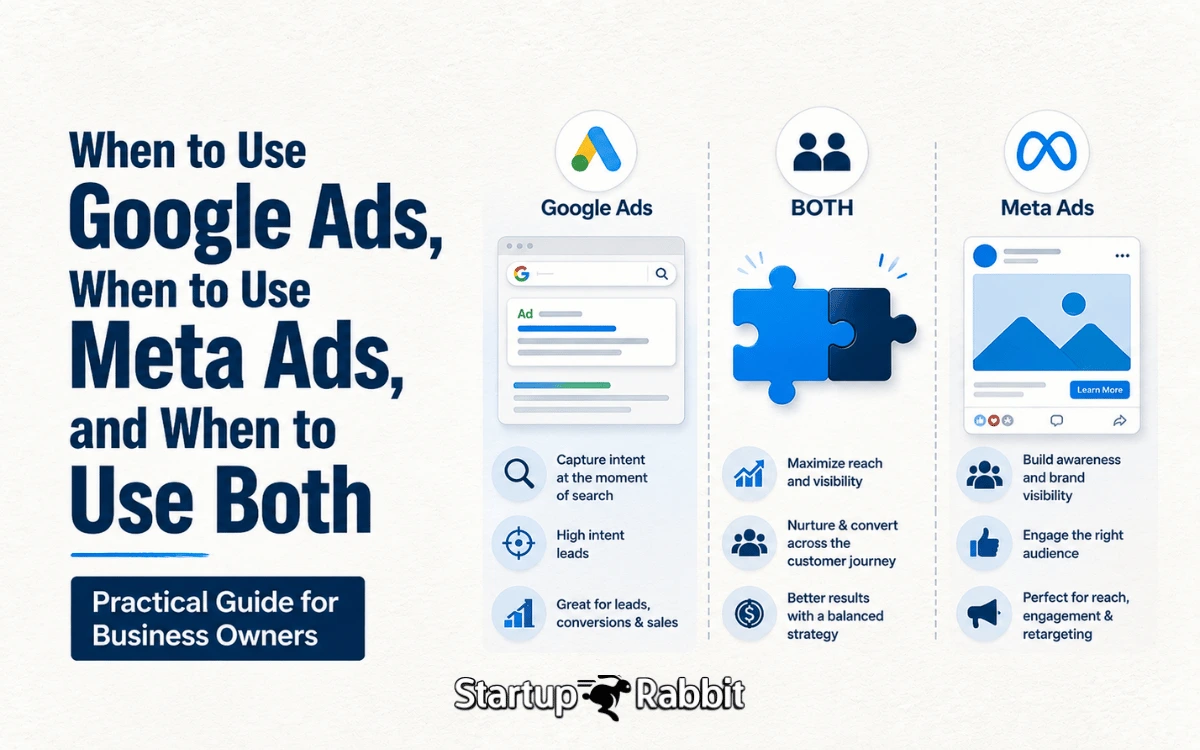
When to Use Google Ads, When to Use Meta Ads, and When to Use Both: A Practical Guide for Business Owners
Almost every business owner eventually asks the same question: should our ad budget go to Google or to Meta (Facebook and Instagram)? The honest answer is that it depends entirely on what your customer is doing at the moment you’re trying to reach them – and understanding that difference is the key to spending your budget well.
Google Ads vs Meta Ads – What’s the Difference?
Google Ads targets your business advertisement to potential customers who are already searching for specific products or services that you offer. Meta Ads shows your business to people scrolling through their feed, based on interests, behaviors, and demographics – regardless of whether they were actively looking for you.
Neither is inherently better. They serve fundamentally different moments in a customer’s journey.
Google Search Ads vs Social Ads – Understanding User Intent
How Google Ads Capture Existing Demand
Someone searching “emergency plumber near me” or “best CA for GST filing Navi Mumbai” already knows what they want. With Google Ads, you are guaranteed that potential customers looking for products or services similar to you will see your business.
How Meta Ads Create New Demand
Someone scrolling Instagram isn’t looking for a plumber – but a well-targeted ad for a new product or service can introduce a need they didn’t know they had, or hadn’t yet acted on.
Choosing Based on the Customer Buying Journey
If your customers typically search before buying (services, emergencies, B2B solutions), prioritize Google Ads. If your product benefits from visual discovery and impulse or consideration-driven buying (fashion, lifestyle, D2C products), Meta Ads often performs better.
Google Ads vs Meta Ads Comparison at a Glance
| Factor | Google Ads | Meta Ads |
|---|---|---|
| Intent | High – active search | Lower – discovery-based |
| Best for | Services, high-intent purchases | Visual products, brand awareness |
| Targeting | Keyword-based | Interest and behavior-based |
| Cost driver | Keyword competition | Audience size and engagement |
| Typical funnel stage | Bottom/middle | Top/middle |
When Google Ads Is the Better Choice
Businesses Selling High-Intent Services
These are services like legal, medical, home repair, etc., where people start actively searching the moment they need them.
Local Service Providers
Businesses with a “near me” feature or ones based on proximity benefit a lot from Google’s strong local intent matching.
Emergency or Immediate Purchase Searches
In such cases, where a customer needs something on the spot, Google Ads is the one place that will capture the moment best.
B2B Lead Generation Campaigns
Top-level decision-makers who are looking for a particular solution usually start by conducting search-based inquiries.
When Meta Ads Delivers Better Results
Ecommerce Brands
Visual product discovery through Instagram and Facebook feeds performs particularly well for physical products.
Fashion, Beauty, Lifestyle and D2C Businesses
These categories benefit from aspirational, visually-driven advertising that Meta’s format supports naturally.
Brand Awareness Campaigns
Meta’s broad reach and visual storytelling capability make it well-suited for building recognition before customers are actively searching.
Community Building and Customer Engagement
Meta platforms support ongoing engagement beyond a single transaction, useful for brands focused on retention and loyalty.
Google Ads vs Facebook Ads in India (Perspective)
Indian consumer behavior increasingly spans both platforms simultaneously – customers may discover a product on Instagram, then search for it on Google before purchasing. This overlapping behavior is exactly why many growing Indian businesses eventually use both platforms rather than choosing exclusively.
Meta Ads ROI vs Google Ads ROI – Which Platform Generates Better Returns?
Return on investment largely depends on your type of business and is not something a general answer can cover. If you’re in a service industry, for example, and target customers with high intent searches, your direct ROI from Google Ads can be quite high. On the other hand, if you are a business selling product in a visually attractive manner, Meta might be best for getting to that wider audience and building brand awareness as an example of overall reach and awareness ROI, especially when the cost per impression at scale is considered low.
Cost Per Lead – Google vs Meta in India
Primary cost drivers for Google Ads are related to keywords, highly searched for keywords in your industry can mean expensive costs per click with a high-quality lead generation. Meta Ads usually comes with a lower CPM, however, there is a need for considerable trial and error with creative and audience selection to obtain a low cost per lead, after all, the ad is not triggered by active user search.
Ad Targeting Comparison – Google vs Meta
Google Audience Targeting
Primarily keyword and search-intent based, supplemented by demographic and remarketing layers.
Meta Audience Targeting
Based on your existing clients, a lookalike audience has been created as well as customers who have demonstrated interest with similar behaviors and demographics.
Which Platform Offers Better Targeting?
Neither is universally better – Google excels at capturing intent, Meta excels at precision demographic and interest-based reach before intent exists.
Remarketing – Google vs Facebook
Both platforms support remarketing to people who’ve previously visited your website or engaged with your content – often one of the highest-ROI campaign types on either platform, since it targets an audience that has already shown interest.
Performance Marketing Platforms – Why Businesses Often Use Both
Rather than treating this as an either-or decision, many growing businesses use Google Ads to capture existing demand and Meta Ads to build awareness and remarket to warm audiences – creating a more complete funnel than either platform alone.
Google Ads and Meta Ads Budget Split
Small Businesses
It is not uncommon for small businesses to initially focus just one platform which aligns with their main immediate need, for instance services providers rely heavily on Google Ads, while product-based companies rely extensively on Meta. Later they can gradually expand to other channels as well.
Growing Ecommerce Brands
It is typical for them to divide almost half of the budget and run ads on Facebook for brand visibility and Instagram/TikTok for capturing people who search on Google and then remarket to them. This is the general strategy.
B2B Companies
Such companies usually put most of their marketing budget on Google Ads and LinkedIn, and they may even use some Meta ads as a supporting element.
Local Businesses
Mostly these businesses rely more heavily on Google Ads to attract direct local searches, whereas local brand awareness is supported through a smaller budget on Meta such as brand awareness and community engagement campaigns.
Common Mistakes Businesses Make When Choosing Between Google and Meta Ads
Firstly Companies may follow what are their competitors doing without considering customer behavior; They terminate one platform too shortly after launching as if they could still do the same and make it up by going to another one; They forget to set the conversion tracking feature on either platform properly; They think that Meta ads will work just like Google or the latter will do without knowing the platforms and their unique strengths. They do not make a proper strategy and creative that fit each platform’s actual strength.
How to Decide Which Advertising Platform Is Right for Your Business
Choose Google Ads If…
It is the right channel for you in several cases such as your customers are looking up for your service on search engines, you are helping people with local or urgent needs, or you are generating leads for B2B deals.
Choose Meta Ads If…
Visuals are an important part of your product offering; you are selling through discovery (not search) or you just want to increase brand recognition or build community, then Meta Ads are right for you.
Use Both If…
You have sufficient resources to run and fine-tune the two at the same time, and your customer journey truly involves discovery and active search phases, a combination that is getting very common in all but the most specialized industries.
Real-World Examples of Google Ads vs Meta Ads
A local dental clinic sees stronger direct booking results from Google Ads targeting “dentist near me” searches, while using Meta Ads to build awareness and showcase patient testimonials to a broader local audience. A fashion D2C brand sees most of its discovery and initial sales from Meta, while using Google Ads primarily for branded search and remarketing to cart abandoners.
Future of Performance Marketing in 2026
With automation powered by AIs, the distinction between platforms is fading, in fact, Google and Meta now heavily rely on machine learning to do targeting and bidding optimization in real time. In 2026, successful businesses will not be ones micromanaging everything, but those who are providing these systems with good creative material and data about sales.
Frequently Asked Questions
Neither is universally better – it depends on whether your customers actively search for your product/service (favoring Google) or discover it through browsing (favoring Meta).
Often yes, on a cost-per-click basis, particularly in competitive industries – but Google traffic typically reflects higher purchase intent, which can offset the higher cost through better conversion rates.
This varies by industry. Service businesses with high search intent often see more direct leads from Google Ads, while product-based businesses often see stronger overall lead volume from Meta once awareness campaigns are factored in.
Yes, though small businesses with limited budgets often benefit from starting with whichever platform most directly matches their customers’ buying behavior, then expanding once initial campaigns are optimized.
This depends on your business model – service businesses often weight more heavily toward Google, product-based businesses often split more evenly or lean toward Meta. A professional audit of your specific customer journey gives the clearest answer.
Most ecommerce businesses benefit from using both – Meta for visual product discovery and awareness, Google for capturing resulting search demand and remarketing to visitors who didn’t convert immediately.
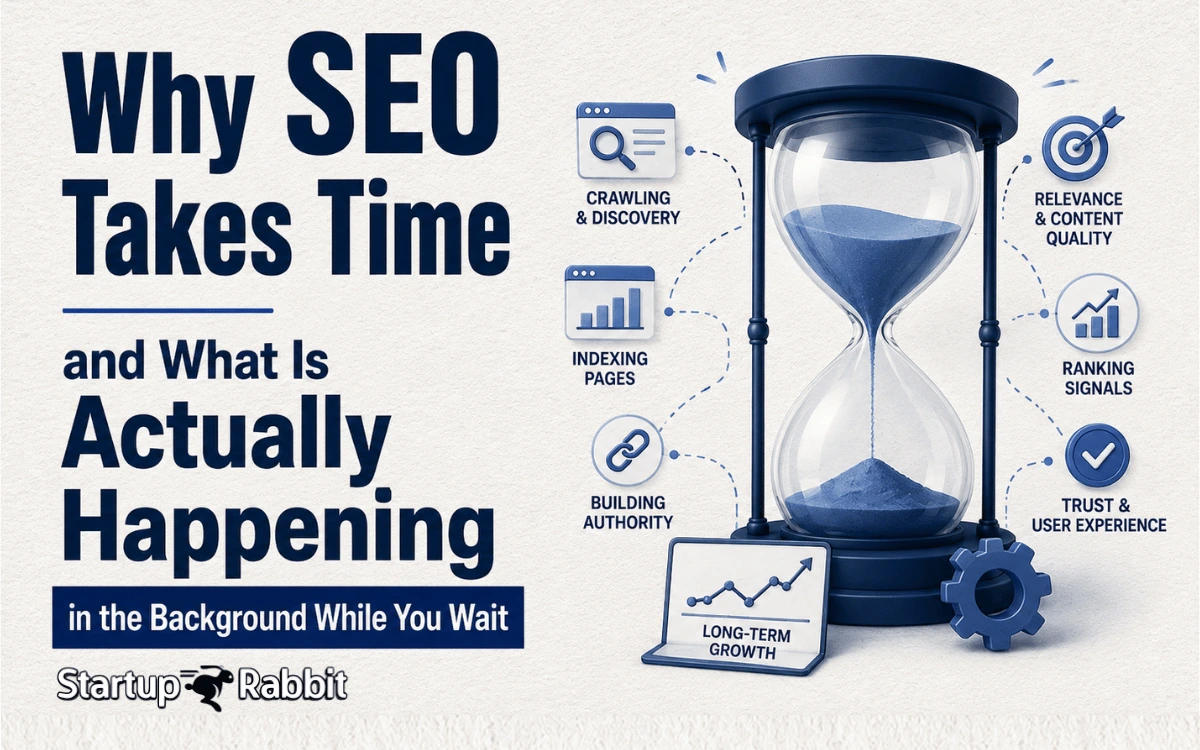
Why SEO Takes Time and What Is Actually Happening in the Background While You Wait
Every business owner asks some version of the same question within weeks of starting SEO: “Why isn’t this working yet?” It’s a fair question – you’re paying for a service, and you expect to see it working. The honest answer is that SEO is working, often from day one, but the results happening behind the scenes take time to surface as visible rankings and traffic.
This guide breaks down exactly what’s happening at every stage, why it takes as long as it does, and what you should be tracking in the meantime.
How Long Does It Take for SEO to Work?
For most businesses, meaningful organic ranking movement begins to show within 60–90 days, with substantial, compounding growth typically visible between months 4 and 12. This isn’t an arbitrary number – it reflects how long Google actually needs to crawl, index, evaluate, and build trust in your website relative to competitors who’ve often had a head start of months or years.
Local, low-competition keywords can move faster – sometimes within 30–45 days. Broader, competitive industry terms almost always take longer, often 6 months or more.
What Happens After You Start SEO? A Month-by-Month Progress Timeline
Month 1 – Website Audit and Technical Improvements
The first month is rarely about content – it’s about foundation. A technical audit identifies crawl errors, broken links, slow page speed, and mobile usability issues. None of these fixes show up as ranking movement immediately, but skipping this step caps how effective every later effort can be.
Month 2 – Content Optimization and On-Page SEO
With technical issues resolved, attention shifts to optimizing existing pages – title tags, meta descriptions, heading structure, internal linking – alongside the start of new, keyword-targeted content creation.
Month 3 – Google Starts Understanding Your Website
By this point, Google has typically crawled and indexed the technical fixes and new content from the previous two months. You may start seeing early movement in Google Search Console – more impressions, small ranking improvements for long-tail keywords – even if it doesn’t yet feel like a breakthrough.
Months 4–6 – Building Authority and Consistency
This is where consistent content publishing and early backlink building start compounding. Rankings for local and lower-competition keywords often become visible and stable during this window.
Months 6–12 – Sustainable Organic Growth
By month six onward, businesses with a consistent strategy typically see meaningful, compounding organic traffic growth. This is also when more competitive keywords start becoming realistically achievable, built on the authority established in earlier months.
Why SEO Takes Longer Than Most Businesses Expect
Google Needs Time to Crawl and Evaluate Content
Google is not a robot that instantly detects new pages and modifications to existing ones. Crawling is done at its own pace. Your site’s authority, sitemap layout, and site update frequency are factors affecting the way this will go.
Content Indexing Time in Google
The page must be indexed, basically it is added to the Google database of the searchable contents; this process has to be done before the page is ready for ranking. Alone, depending on site Authority, this part can take anywhere between a couple of days and a few weeks.
Building Trust and Authority Takes Time
Google is just going to be the reason a brand new site is or is a low-authority site is high for competing phrases regardless of how good your content is. It is trust, however, that is earned slowly over a series that includes the consistent and high-quality signals. There just is no way to bypass this one.
SEO Is Continuous, Not a One-Time Project
In contrast to a single website redesign or any other form of marketing, Google SEO does not come to an end. You need rankings not only maintained but continuously improved, else their decline becomes inevitable as your competitors carry on creating and enhancing their content.
Factors That Affect How Long SEO Takes
Website Age and History – Older domains with a clean history generally build trust faster than brand-new websites.
Competition in Your Industry – Highly competitive industries (legal, finance, real estate) take longer to rank in than niche or local services.
Domain Authority Timeline – Authority builds gradually through consistent quality content and backlinks; it cannot be rushed without risking penalties.
Website Structure and Technical Health – A well-structured, fast, mobile-friendly site gives every other SEO effort a better foundation to work from.
Content Quality and Publishing Frequency – Consistent, genuinely useful content compounds faster than sporadic, thin content.
Backlink Profile – Quality backlinks from relevant, authoritative sites accelerate trust-building significantly.
Search Intent and Keyword Difficulty – Informational, long-tail keywords rank faster than short, highly competitive, commercial terms.
Does a New Website Take Longer to Rank?
Generally, yes. New websites often experience what’s commonly referred to as the Google Sandbox effect.
Understanding the Google Sandbox Effect for New Sites
Although a Google representative hasn’t officially revealed or confirmed this system, patterns have been spotted by many people that new websites are subjected to a trial period during which their visibility in search rankings doesn’t really reflect well-optimized content. The problem seems to disappear after a few months if the website is consistently producing good content.
SEO Results Timeframe in India vs Competitive Global Markets
Competition varies significantly by market. Businesses targeting keywords in dense, competitive hubs – Mumbai, Delhi, Bangalore – often face longer timelines than businesses in less saturated regional markets. For Navi Mumbai businesses specifically, local SEO often presents a faster, more achievable path than competing directly for broad, national-level keywords from day one.
Can Local SEO Deliver Faster Results?
Why Local SEO Often Shows Results Earlier
Local search has significantly lower competition than broad national or global keywords, meaning meaningful visibility can be achieved faster – often within 60–90 days for Google Business Profile and Maps-related visibility.
Factors That Influence Local Rankings
Proximity to the searcher, Google Business Profile completeness, review quantity and quality, and local citation consistency all play a significant role, independent of your broader website’s overall SEO health.
Google Business Profile Optimization Timeline
A fully optimized Google Business Profile can start showing improved visibility in local search and Maps results within just a few weeks – one of the fastest-moving components of any SEO strategy.
Why Some Websites See SEO Results Faster Than Others
Sites that already have some existing authority, clean technical health, and a head start on content typically see faster results than businesses starting completely from scratch. This is why an initial audit matters so much – it reveals exactly where you’re starting from.
Common Reasons SEO Takes Longer Than Expected
Targeting Highly Competitive Keywords
Trying to rank for broad, high-competition terms too early, before building sufficient authority, often means months of effort with little visible movement.
Publishing Thin or Low-Quality Content
Content written primarily to hit a word count or keyword quota, without genuine depth or usefulness, rarely ranks well or holds its position.
Ignoring Technical SEO
Even excellent content can be held back by poor site speed, broken links, or crawlability issues that quietly undermine every other effort.
Poor Internal Linking
Weak internal linking structure prevents authority from flowing properly between pages, limiting how well newer or less prominent pages can rank.
Inconsistent SEO Strategy
Starting and stopping content or link-building efforts repeatedly resets momentum and significantly slows overall progress.
SEO vs Paid Ads – Which Delivers Results Faster?
Paid ads deliver visibility almost immediately – often within hours of launching a campaign. SEO takes months to build the same visibility organically, but unlike ads, it continues delivering traffic without ongoing spend once established. Most businesses benefit from using both together: ads for immediate visibility, SEO for sustainable, long-term growth.
What You Should Track Instead of Rankings Alone
Organic Impressions
How often your pages appear in search results, even before clicks happen – an early signal Google is starting to recognize your content.
Keyword Visibility
The overall spread and movement of keywords you’re ranking for, not just one or two target terms.
Indexed Pages
How many of your pages Google has actually added to its index – a foundational metric for any SEO progress.
Organic Traffic Growth
The clearest overall signal of SEO progress, tracked month over month rather than day to day.
Conversion Rate
How effectively your organic traffic is turning into enquiries or leads – traffic alone isn’t the end goal.
Qualified Leads and Revenue
Ultimately, the metric that matters most to your business – is SEO actually contributing to growth, not just visibility.
How to Speed Up SEO Results Without Taking Shortcuts
Fix Technical Issues Early
Resolving crawlability, speed, and mobile issues first ensures every subsequent effort has maximum impact.
Publish Helpful, Intent-Focused Content
Content that genuinely answers what your audience is searching for outperforms content written purely to target a keyword.
Strengthen Internal Linking
A thoughtful internal linking structure helps distribute authority across your site more effectively.
Build High-Quality Backlinks
A smaller number of relevant, authoritative backlinks accelerates trust-building far more than a large volume of low-quality links.
Update Existing Content Regularly
Refreshing outdated content signals ongoing relevance to Google and often recovers or improves rankings faster than publishing new pages alone.
SEO Is an Investment, Not an Expense
Unlike paid advertising, which stops generating traffic the moment you stop spending, SEO builds a compounding, long-term asset. The months of groundwork are what make years of consistent, low-cost organic traffic possible afterward.
Signs Your SEO Strategy Is Actually Working
Rising organic impressions and click-through rate in Search Console, gradual improvement in keyword rankings (even outside your top targets), increasing indexed pages, growing referral and organic sessions, and a steady rise in enquiries or leads sourced from organic search are all strong signals that your strategy is on track, even before you’re ranking #1 for your primary keyword.
Frequently Asked Questions
New websites typically take longer due to the Google Sandbox effect – expect initial movement around 3-4 months, with more substantial results building from month 6 onward.
Technically, SEO starts working from day one as changes are implemented, but visible ranking movement typically appears within 60-90 days.
For very low-competition, hyperlocal keywords, some early movement is possible. For most competitive terms, 30 days is too early to expect significant visible results.
This usually points to unresolved technical issues, thin content, weak backlink profile, or targeting keywords that are too competitive relative to your site’s current authority.
Yes, generally. Local SEO faces less competition and relies heavily on factors like Google Business Profile optimization, which can show results within weeks rather than months.
Focus on technical fixes, genuinely useful content, and quality (not quantity) backlinks. Avoid shortcuts like keyword stuffing or bulk low-quality link buying, which risk penalties that set you back further.
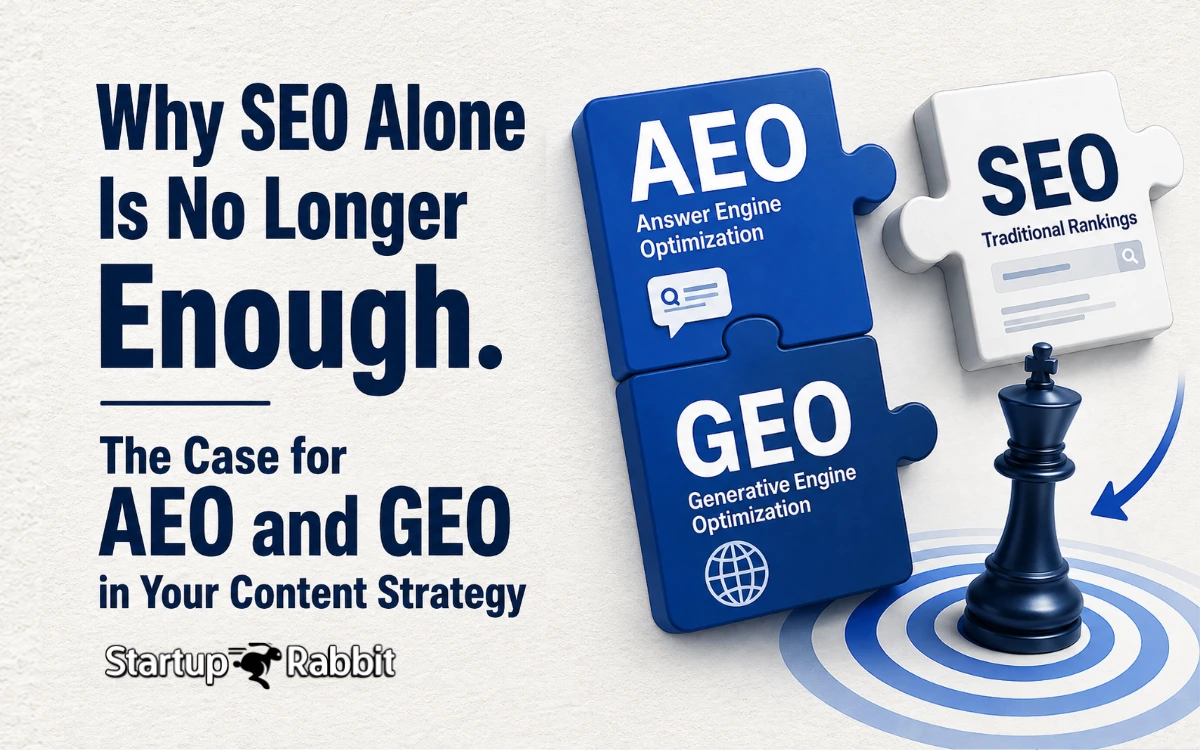
Why SEO Alone Is No Longer Enough. The Case for AEO and GEO in Your Content Strategy
Search has evolved from blue links to a rich mix of answers, conversations, and AI-generated responses. The SEO of the past involved optimisers vying for page-one placement; that’s now just one piece of the pie. As answer engines, AI assistants and generative models alter information retrieval, modern practitioners need a wider range of tactics. Here we will explore why SEO vs AEO vs GEO matters, how search has changed. Also, the steps the teams must take to develop a combined content approach that will keep brands discoverable across search, answer, and generative models. We will focus on actionable insights for Indian content marketers and companies preparing for a competitive landscape by 2026.
Understanding SEO vs AEO vs GEO
What Is Search Engine Optimisation (SEO)?
SEO (Search Engine Optimization) involves tuning your website’s content, architecture, and authority to increase the ranking in search engine result pages and drive more free/organic traffic. At its essence, the practice of SEO helps search engines to understand and associate your content with user search terms.
What Is Answer Engine Optimisation (AEO)?
AEO means content optimization for quick retrieval searches for search engines and AIs like Siri and Alexa, not for page rank in web search. AEO means optimization for Featured snippets, Knowledge graphs and for voice search ranking for the user’s need of getting answers instantly.
AEO wants users to get their answer straight away, so this makes the AI much more accessible to index and crawl your content. It makes it more conceivable that your pages will feature in a direct answer and a voice search.
What Is Generative Engine Optimisation (GEO)?
GEO is the process of structuring your content in a way that AI search engines like ChatGPT and Google Gemini can understand and recall information from. AI search engine result pages are not websites. But they collect information to help directly answer a question. There is an increased chance that your content will be AI with GEO.
Why These Three Strategies Are Often Confused
SEO, AEO, and GEO are three integrated efforts for online discoverability. But they’re interacting with entirely different sets of algorithms and user intents. What can be confusing is that all three involve a search algorithm. However, their objectives and how each of the platforms serves varied data.
How Search Behaviour Has Changed in the AI Era
1. Key phrases are phased out in favor of actual conversation. Users will engage with longer, conversational search queries that will undoubtedly drive the use of natural language processing (NLP).
E.g., “What’s the greatest trick to tame frizzy curly hair in humid and tropical climates?”
2. Search on many platforms will take off as ChatGPT takes the reins in the AI search space. This will also lead more Gen Z to rely on TikTok as well as Instagram for authentic content.
3. Zero Click will take away from the way users engage online; it will NOT eradicate any form of organic traffic, but will significantly decrease the opportunity of any top ranking content reaching some organic click traffic.
Search Engine Optimisation vs Answer Engine Optimisation
Traditional Ranking Goals of SEO
An SEO user would land at a website either for in-depth information or an immediate answer, such as from a SERP feature. An AI search engine, conversely, would simply deliver the full answer at the top from AEO.
How AEO Focuses on Answer Visibility
AEO uses your content and links your source (when referenced and mentioned) within AI search answers (and voice search), to increase brand visibility and drive organic traffic.
User Intent Differences Between SEO and AEO
An SEO user lands on a site for additional context or an instant answer via a SERP feature. An AI search engine delivers in-depth context directly from AEO.
When Businesses Should Prioritise Each Strategy
While SEO helps rank higher and appears higher up on search and within AI generated answers, the benefit is to capture the organic traffic. Conversely, AEO’s goal is to be seen within the AI by means of citations and brand placement in an AI generated response.
Where GEO Fits Into Modern Search Marketing
“Zero-click” searches and AI Overviews are leading to a decline in site clicks. If your brand is stuck in the internet’s “link layer,” you’re now out of sight for millions of users. Instead, they’re discovering the world through AI assistants.
GEO is our modern marketing approach to grabbing your share of the “Response Layer” because AI engines don’t index and rank like Google’s old approach. They care about:
- Semantic Depth – Does this content really say something about the topic or is it filler?
- Trust Signals – Do other sources of authority mention your brand?
- Structure – Is information logically formatted for instant machine processing?
SEO vs AEO vs GEO – A Side-by-Side Comparison
| Feature | SEO (Search Engine Optimization) | AEO (Answer Engine Optimization) | GEO (Generative Engine Optimization) |
| Primary Goal | Rank higher on search engine result pages (SERPs) to earn clicks. | Provide direct, concise answers for featured snippets and voice assistants. | Ensure your brand/content is used and cited as a trusted source by AI models. |
| Target Engine | Traditional engines (Google, Bing, Yahoo). | Answer engines (Google Featured Snippets, Siri, Alexa). | LLMs & AI platforms (ChatGPT, Perplexity, Claude, Gemini). |
| Key Focus | Broad/transactional keywords, page authority, and backlinks. | Natural language, Q&A formats, and structured data/schema markup. | Information gain, entity authority, and deep topical expertise. |
| Success Metric | Organic traffic, rankings, and click-through rate (CTR). | Answer box placement, voice visibility, and zero-click engagement. | Share of voice, AI citation rate, and brand mention frequency. |
Why SEO Alone Is No Longer Enough
SEO on its own is insufficient due to the increased competition in search results. Enhanced visualization and zero-click direct answers result in page rank alone but do not provide traffic or leads.
Presently, users often find answers through snippets, AI summaries, and zero-click results. Therefore, few people visit the website even though the content may rank well.
Brands must also distribute content across various platforms such as social media, email, video, and LinkedIn, where buyers actually consume content.
So now, authority holds the same weight as keywords. Businesses need to foster trust by offering valuable information, insight, and a unified brand presence.
Ultimately, when you boil it down, SEO can be a piece in the larger marketing picture, but not the entire picture itself. As all three components are interrelated.
Google SGE Impact India – What Businesses Should Know
Understanding Google’s AI-Powered Search Experience
Google Search Generative Experience (SGE) is an AI feature that enhances the standard Google search results with conversational and contextual elements. Rather than sending users back to links, Google now shows natural language processing summaries, insights, and recommendations directly on the search results page.
How SGE Changes Search Result Layouts
The user can produce images by, for example, the prompt “Draw a futuristic house” or “See a lake in a calm evening.” Images produced by the system are shown as a slideshow, and clearly identified as AI-generated images. This integrates into Google Image search and is accessible through Google Search Labs.
Effects on Organic Traffic and Visibility
Thought leadership is a good strategy. It educates the audience with content that links to SGE answers without needing to click on the website. It gives the brand the presence and authority it seeks. Although traffic may not increase, the traffic will be more engaged and higher quality. Consider taking your written content and creating video summaries, audio snippets, or assorted interactive formats to make it more eye-catching. What’s more, with a Local SEO campaign, companies can show up in neighbourhood searches, which is bound to raise their presence in more compact markets.
Opportunities for Brands That Adapt Early
With an SGE landscape, having one of the top positions within the SERP doesn’t necessarily drive the most traffic. Rather, such an inclusion in machine-generated summaries is steadily becoming more valuable. This change requires SEO marketers to reconsider how to incorporate the new KPIs and metrics into their workflow, including previously unheard of “snapshot inclusion rate.” For AI to make improvements to visibility, marketers need to shift their emphasis to broader content planning strategies. They need to move beyond keywords to take context, entity relationships, and (user) intent into account.
AI Search Visibility India – How Brands Can Stay Discoverable
Building Authority Beyond Rankings
It is important for brands to highlight their credibility across several platforms as AI platforms look at brands with high authority and trust signals and expertise.
Optimising Content for AI Citations
Content that is well-structured, clear, and relevant is more likely to appear in AI-driven search results.
Creating Reliable and Verifiable Information
Use primary data to link to, use author bios, include methodology to increase trust signals for AI systems.
Establishing Strong Topical Expertise
Move beyond keyword ranking to becoming the dominant players in a topic’s niche. It means publishing clusters (bundles) of blogs, building comprehensive guides, employing the multiple usage of the same topics in different ways, along with positioning your brand as an industry authority. SEO and content strategies are integrated to create long-term strategies for boosting AI recognition.
Content Strategy SEO AEO GEO – Building a Unified Framework

How to Optimise for AI Answers in 2026
Optimise for AI answers in India: For questions in your content, provide a summary of 40 – 50 words that answers the question, as the first content in the post. Engage through conversational headings (rather than question headings).
Leverage schema markup and use bullets: Make your content read and understood by the AI by creating machine-readable content. Use an llms.txt file for AI crawlers, and make it accessible. As a result, you possibly can rely on little JavaScript.
Brand Trust (E-E-A-T): Authorship information and entity consistency might reflect your authority. Get external endorsements – through digital PR and citations.
Track Success: Expand upon traditional rank tracking and monitor interactions with AI. Brand prompting and measuring your AI citations with GA4 in reference to your referral traffic with UTM tags.
Search Intent Optimisation Across SEO, AEO, and GEO
Information Intent: The user is trying to learn or find an answer to a question (e.g. what is the future of search marketing in India). This will be met with long-form content, featured snippets or knowledge panels. Blog posts, faqs, tutorials and explainer videos are excellent here.
Navigational Intent: Google helps them get there like “Ahrefs login”. Unless your content specifically focuses on brand-based results. There are few opportunities here, and misunderstanding that these results is a good recipe for a bounce.
Commercial Intent: The intent to search for a specific type of product or services and to compare potential options before buying. “best keyword research tools”; is best practice for commercial intent content. This content is comparison articles, buying guides, product reviews, and case studies.
Transactional Intent: It means the intent to purchase, like “buy running shoes online”; to attract and convert this intent. Thereby, content types must focus on a specific product or service, the most common being product pages with very prominent calls to action (CTAs).
ChatGPT, Perplexity, and the Future of Search Discovery
| AI Search Platform | What It Rewards in 2026 | Google, ChatGPT, Perplexity, search SEO Tips |
| Google AI Overviews | Pages that demonstrate strong E-E-A-T (Experience, Expertise, Authoritativeness, Trustworthiness) and provide genuinely helpful, people-first content. | – Include first-hand experience with real implementations, client results, or tested methodologies. Build entity associations using structured data that connects your brand, authors, and topics to recognized knowledge graph entities. Support claims with primary source citations, such as research studies, official documentation, and regulatory guidance. Display author credentials through detailed author pages, verified expertise, social profiles, and publication history. Lastly, focus on helpful, user-first content instead of writing primarily for search engines. |
| Perplexity AI | Content that is factual, transparent, well-structured, and easy to cite. | – Start with a direct answer in the opening paragraph. Use question-based headings that match common user searches. Include specific statistics and data with clearly attributed sources. Publish consistently to build topical authority and domain trust. Last but not least, avoid thin content, excessive promotional language, and lengthy introductions before the main answer. |
| ChatGPT (Search-Enabled Modes) | Content that is easy for AI systems to extract, understand, and reuse. | – Write short, standalone paragraphs that make sense without surrounding context.- Use definition-first formatting, explaining key concepts in the opening sentence.- Add FAQ sections with concise, direct answers.- Implement structured data (Schema Markup), especially FAQ, HowTo, and Article schema to improve content organization and AI discoverability. |
Common Mistakes Businesses Make When Adopting AEO and GEO
Common Mistake 1: Overlook conversational and long tail search intent. Missing opportunities by not answering how natural conversations and long-tail searches work for AI-driven searches.
Fix: Include question-related headlines – plus use natural search language and phrases. Use the tools People Also Ask and AnswerThePublic for popular search terms and topics.
Common Mistake 2: Forgetting Schema Markup and Structured Data. How you structure data is going to hinder the search engines ability to understand your content.
Fix: Use schema markup for things such as FAQ, HowTo and other things applicable on all your pages. Validate it with Google’s Structured Data Testing Tool to check for mistakes.
Common Mistake 3: Keyword Stuffing and unnatural language. A website plagued with “keyword stuffing” works against the website and search engines want something with rich semantic data and not keyword density.
Fix: Repetition in terms of language and synonyms. View semantic data with tools.
Common Mistake 4: Ambiguous or fluffly answers. Providing vague answers is something AI will pass by in favor of concise and informative ones.
Fix: A direct answer to a question can be found in 1-2 sentences at the beginning of the content; afterward provide more detail if need be.
Common Mistake 5: Mobile Optimization and Voice Search. Not having mobile optimization or optimizing for voice search could decrease the chances of it appearing in a search summary.
Fix: Write in a natural way, the page loading speed is important, test to see what answers can be read from the screen by a voice assistant.
AEO GEO SEO Strategy 2025 and Beyond
SEO is about old-fashioned discoverability, and optimizing to get a good ranking on Google search engine result pages. Linking content to user intent is key, as is fast page speed and secure HTTPS, as well as acquiring quality backlinks to build authority.
2. AEO focuses on delivering short information on the zero-click searches and voice queries. Here are some actionable tips: have FAQ blocks, formatting, and schema markup.
3. GEO wants to establish its brand trustworthiness on various AI platforms. This also includes keeping brand consistency from your website across digital platforms. Also create in-depth content and conducting digital PR to improve brand visibility in AI training sets.
4. Tracking Performance uses two strategies:
- Google’s Search Console for SEO (Google’s data)
- AI such as ChatGPT for brand mentions, in AEO and GEO.
Future of Search Marketing India
1. The Rise of “Zero-Click” Interactions
Search engines are shifting from sending people to sites to directly answering their queries on the results page. As it’s predicted, website traffic may decrease with informational queries-since people can get answers like “list of CRMs for startups in Bangalore” directly from the SERP. Businesses will need to make sure they appear on these answers instead of just getting clicks.
2. Multimodal Search Becomes Standard
Voice, video, and visuals will be part of search by 2030. Users will be able to perform a search by simply looking through their cameras, or via spoken voice commands. Content with clear visuals (images, video) will be important.
3. Hyper-Personalization
Search results will be fully personalized; your search will factor in budget, taste, and location. It is in other words two persons searching for ‘generative engine optimisation India’ will have two different outcomes.
4. Predictive Search
Search results may become predictive, providing options by accessing a user’s calendar and purchase history. Search will go from being a reaction, to something more proactive.
Practical Framework for Combining SEO, AEO, and GEO
- Consider existing content for SEO effectiveness and AEO readiness (frequently asked questions) and GEO suitability (depth and authority).
- Know what keywords to use for SEO, questions to ask for AEO and subjects for GEO that are often referred to on AI platforms.
- Write keyword-rich, answers or answers for specific questions, relevant keywords, and content with in-depth information (AEO, SEO, GEO).
- Implement structured data, enhance site speed, and mobile-friendly and mobile responsive to meet both the SEO and AEO needs.
- Monitor performance with each of the three optimization areas and take necessary adjustments.
- Gain authority, reputation and trust via back-links (SEO), customers and followers (AEO) and in-depth, trusted information (GEO).
- Use multiple access points such as traditional websites, voice assistants, and AI platforms to spread your content out as far as possible.
Conclusion
SEO vs AEO vs GEO can no longer be separate strategies; they are increasingly complementary in securing visibility for a brand within the emerging AI ecosystem. SEO continues to drive traffic and conversions, AEO claims the top position to steal eyeballs, while GEO lands customers into the AI’s direct answer. As brands in India and beyond build their online strategy, a multi-layer optimization strategy will be key. From short, citable answers that power AEO, authoritative pillar content for SEO, and well-sourced, structured content for GEO, brands must cater to user intent, utilize schema markup, and measure AI citations to achieve success.
FAQs
SEO means being the answer, not ranking on the standard search result page. AEO means being the direct, instant answer. GEO ensures you’ll be the reference that an AI mentions.
No, GEO (Generative Engine Optimization) is not a replacement for SEO.
AEO is becoming important because of the rise of generative responses and voice-based search.
Google SGE, now called AI Overviews changes the nature of SEO because it creates AI based answers at the top of a search results page.
As we are shifting to an AI powered search engine, businesses have to reevaluate and redefine their SEO strategy and moving from a Click SEO approach to GEO search.
To lead in AEO, a company should concentrate on writing conversation-oriented and well-structured content. This content immediately responds to the user query and also becomes a citation in AIs such as ChatGPT and Perplexity.
When you feed any query to ChatGPT to retrieve data from the internet, it uses an artificial intelligence technique named Retrieval Augmented Generation (RAG).
The future of SEO moves away from the traditional keyword ranking chase and into being AI aware and cited in a synthesized result.
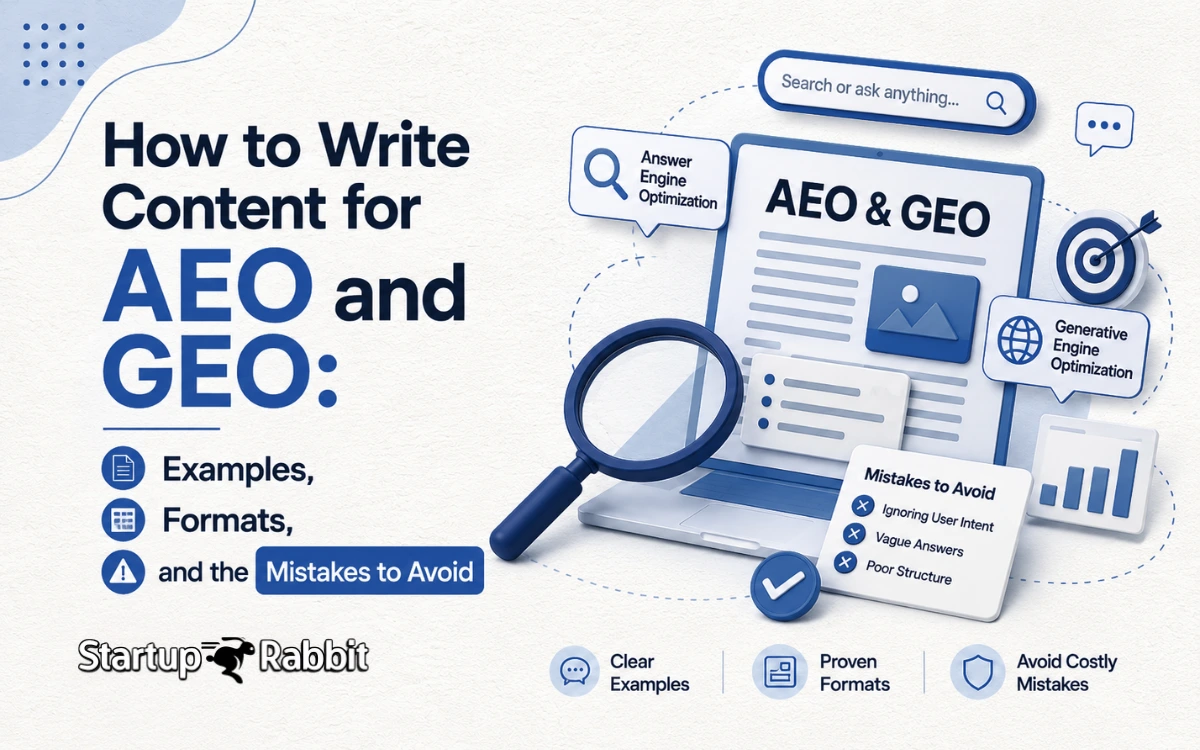
How to Write Content for AEO and GEO: Examples, Formats, and the Mistakes to Avoid
As AI assistants and generative models are able to read and summarize content and then reply in response to users’ questions, it is now essential to create content appealing to machines and humans. This guide will provide you with content writing tips for AEO (Answer Engine Optimization) with easy-to-understand examples, formats and pitfalls to avoid. We will look at pre-designed templates, example of content for AEO and GEO, and simple instructions to use. Furthermore, to help your web pages appear in the highlighted snippets, AI citations and ChatGPT-like conversations.
What Is AEO and GEO?
Understanding Answer Engine Optimization (AEO)
AEO is the optimization of content for quickly-retrieved searches by search engines and AIs like Siri and Alexa, rather than the ranking of pages for web search. The purpose of AEO is to achieve featured snippets, knowledge graphs and voice search ranking, which helps satisfy user demand for instant answers. AEO want users to get their answer straight away, so this makes the AI much more accessible to index and crawl your content. It makes it more conceivable that your pages will feature in a direct answer and a voice search.
What Generative Engine Optimization (GEO) Means
GEO is the process of structuring your content in a way AI search engines like ChatGPT and Google Gemini can understand and recall information from. AI search engine result pages are not websites, but they collect information from websites to help directly answer a question. There is increased chance that your content will be AI with GEO.
How AI Search Is Different From Traditional Search
| Feature | AI Search (e.g., ChatGPT, Gemini, AI Overviews) | Traditional Search (e.g., Google) |
| Output Format | A direct, synthesized answer or summary. | A ranked list of “blue links” and web pages. |
| Query Input | Long, natural language and conversational prompts. | Short, structured keyword-based queries. |
| Information Gathering | Machine effort: The AI retrieves multiple sources and does the synthesis for you. | User effort: You click, read, and synthesize data across multiple pages. |
| Context & Memory | Remembers past prompts in the session, allowing multi-turn, conversational follow-ups. | Treats every query as an isolated, one-off search. |
| Authority | Relies on contextual accuracy, source credibility, and cross-source verification. | Relies on domain authority, keywords, and backlinks. |
Why Businesses Need Both AEO and GEO Strategies
AEO and GEO working together allow brands to target all forms of modern search and ensure they aren’t lost in the new AI chatbots that have supplanted traditional search engines for some tasks. AEO wins brand presence on voice search and featured snippets, while GEO can achieve branded results directly in an AI-synthesized response with citations and referrals.
AEO vs GEO vs Traditional SEO
| Aspect | Traditional SEO | AEO | GEO |
| Goal | Rank in top 10 results | Be extracted for direct answers | Be cited in AI-generated synthesis |
| Target Systems | Google/Bing organic rankings | Featured snippets, voice search, AI summaries | LLM citation in ChatGPT, Claude, Gemini, Perplexity |
| Primary Metric | Keyword rankings, organic traffic | Snippet ownership, voice response frequency | Citation frequency, Share of Voice in AI answers |
| Core Tactics | Backlinks, keywords, technical health | 40-60 word answers, Q&A format, FAQ schema | Expert quotes, statistics, consensus building, inline citations |
| Content Style | Comprehensive, keyword-optimized | Concise, question-focused, structured | Evidentiary, citable, authoritative |
| Success Signal | Position 1-3 in SERPs | Featured snippet or “People Also Ask” inclusion | Brand mentioned in AI Overview or Perplexity answer |
Why Content Structure Matters for AI Search
- Use modular content blocks: AI views content as individual modules instead of scrolling down a page. So every piece of content you write should be self-sufficient. The page should stand on its own and not depend on external sources of content.
- Include semantic formatting: The more structured your content, the better AI can understand context and navigate the content on a page. It uses heading tags, bulleted lists, tables, or structured HTML; schema markup improves accuracy for search engines and AI in general.
- Structure the facts: Use comparison tables, lists, and Q&As wherever you can instead of a long paragraph. Structured text makes it easier for AI to quickly check prices, technical specifications, and prices, and minimizes the chance of AI misinterpreting what your information states.
- BLUF Principle: Begin every section with the BLUF (Bottom Line Up Front) and clear headings to make it obvious what the key takeaway is and for AI to reference it in search results.
Example of Content for AEO and GEO – Understanding the Difference
1. Capturing a definition-focused query (AEO).
A martech vendor increases visibility to “what is marketing automation.” A page with a clear definition at the top, an elaborated system, common use cases, and surrounding terms increases the chance of a page ranking in answer-box-like SERP features. The martech vendor isn’t only supplying definitions content, but also descriptive page headlines, standalone answer content segments, and schema markup. Slap search engine context to your internal linking and ensure a slick UX. This helps to improve their chances of being referenced in an answer box even when no one click through.
2. Earning AI citations (GEO).
A Fortune 500 analytics company presents themselves as a thought leader on ecommerce trends by putting data and insight at the service of their clients to create a report that delivers specific facts and context. The content of the issues in the report is original and using their data, the information presented is highly credible and of an actionable type, for enterprise marketing organizations. This style of content is quite likely to return anytime an AI searchees for e-commerce trend content.
AEO Content Format Examples That Win Featured Answers
Definition-Based Content Example
Your definition begins with one single sentence and your expanded answer is 40-60 words followed by your one-line source.
Step-by-Step Instruction Format
Number your format with a simple, actionable step, the estimated amount of time required, or the tools you need.
Question-and-Answer Content Structure
Questions that many people will wonder are written in H3 with the answers just underneath.
Comparison Content Designed for Answer Engines
Finally a short table or bullet point list that compares things in 3 to 5 concise points.
Featured Snippet Content Example: Structuring Content for Quick Answers

GEO Optimised Content India – Best Practices for Local Businesses
- Audit your service pages and blogs for pages that answer users questions in the moment.
- Rewrite your introductions to provide a straightforward answer
- Include schema markup in the FAQs and create / group content into a topical page hierarchy to show topical authority,
- Include author credentials, client reviews and references in order to increase the E-E-A-T.
- Finally, measure the frequency that your brand is referenced in tools such as ChatGPT, Perplexity and Google AI Overviews and monitor performance in organic search.
How Indian Businesses Can Benefit From GEO
This is not a solution only for those that have national or international reach. Even a small shop around the corner stands to benefit. When you search terms with an AI tool like “best digital marketing agency in Vashi”, or “example of content for AEO and GEO,” the answer comes from your business profiles, structured pages and reviews.
For international clients, the new AI solution opens a real window. It provides the opportunity for any Indian company that puts up rich, authoritative content, structures the content well, uses schema and E-E-A-T signals. It appears in the answers of AI for users from countries like the United States, United Kingdom, Australia, etc.
AI Answer Content Structure That Search Engines Prefer
- Generate sections, where each section contains answers to one and only one question or sub-question and can be independently reused or edited.
- Include clear hierarchical structure like H2, H3 and H4. H2 clearly outlines what question or topic is being covered. H3 and H4 are used to clarify scope and intent.
- Be clear and explicit; don’t assume the reader, or AI, can or will figure out cause-and-effect relationships, explicit definitions and answers.
- Put the answer first. Each content section should contain a direct answer to the question asked followed by evidence, reasoning and examples that support it.
- Optimize each section should contain an answer that will work alone and be extractable for direct presentation by a search engine, without edit.
FAQ Content AEO Strategies for Higher Visibility
- Clearly organized semantic structure: Each FAQ forms a self-contained semantic unit, with a specific question presented in it, and a direct answer. This makes the AI answer engine more easily digest, extract and serve accurate responses.
- Enhances AI content extraction: In a long-form content, the key information may be scattered across different sections in different places. But when it’s confined to FAQ content, it will ensure that the context and the answer are together. This helps to minimize ambiguity, and makes it easier for AI systems to identify reliable information quickly.
- Match uses natural language for the user: FAQs are written conversely, like in interacting with an AI assistant. Rather than throwing in lots of terms to your posts, they answer authentic questions for example “How can I pick an e commerce platform that works for my business? That’ll make the answer more relevant and the likelihood of being chosen as an AI-generated answer much higher!
- Enhances content visibility on AI search and answer tools: The FAQ format is easy to reference, summarize, and cite for AI models. This will enhance the visibility of your content on AI-powered search and answer tools.
How to Write for AI Search Engines Without Losing Human Readability

Content for ChatGPT Search India and Other AI Platforms
- Provide useful information: Create and share useful information that directly addresses your customers’ questions and solves their issues. This can help to develop handbooks of your experience and make sure that AI systems have accurate data to refer to.
- Boost the local newspaper influence and seeming agency: Obtain mentions on neighborhood web pages, neighborhood directories, commercial associations, and neighborhood teams. These signals lend credibility and bolster your online reputation.
- Set up FAQ pages: Develop FAQ pages which provide direct answers to customer questions. Well-organized FAQs allow for better comprehension of your business both for your business and an AI platform.
- Update the website regularly: Always update your service pages, new blog posts, customer testimonials, business information, etc. A fully functional website indicates that your business is trustworthy, interesting, and cared for by search engines and AI systems.
Schema Markup GEO Content – Enhancing AI Understanding
What Schema Markup Does for Search Engines
Schema markup enables search engines to interpret the information found in web pages.
FAQ Schema for AEO
- Function: Hyperlinks and enriches Q&A sections for good search results when looking for FAQs.
- Ideal use: Service pages, help centres, educational content.
Article and Organization Schema for GEO
- Function: Makes it easier to find blog articles or news on the internet.
- Contains: Title, author, release/s and featured image.
- Ideal for: Blogs, news publisher, news site.
Common Structured Data Mistakes
- Add all required properties: Add all required properties of the chosen type of schema. If any properties are left out, search engines might not be able to leverage your structured data.
- Match schema for page content: Be sure your page content has a correct corresponding schema. Don’t include irrelevant/redundant information.
- Error free syntax: Use valid and properly formatted JSON-LD. Use the Google Rich Results Test before publishing your markup.
- Use the appropriate schema type: Use the most specific schema possible, in this case, the page, and don’t mark up anything that isn’t related.
- Where applicable: Only use page-specific schemas on applicable pages and not throughout the website!
- After using the review schema correctly: Respect the review guidelines put in place by Google and annotate only real, eligible reviews.
Common Mistakes That Prevent AEO and GEO Success
| Common Mistakes That Prevent AEO and GEO Success | Why It Hurts | How to Fix It |
| Ignoring Conversational and Long-Tail Search Intent | Focusing only on broad keywords can cause you to miss users who search using natural, question-based queries. | Use conversational keywords, question-style headings, and answer common user queries. Tools like AnswerThePublic can help identify relevant questions. |
| Not Using Schema Markup and Structured Data | Without structured data, AI search engines may struggle to understand and display your content accurately. | Add relevant schema such as FAQPage, HowTo, and other structured data. Validate your implementation using Google’s Rich Results Test. |
| Keyword Stuffing and Unnatural Language | Overusing keywords reduces content quality and makes it less useful for both users and AI systems. | Write naturally, use synonyms and related terms, and focus on readability instead of repeating the same keywords. |
| Providing Fluffy or Indirect Answers | AI-powered search engines prefer concise and direct answers that quickly address the user’s query. | Start with a clear one- or two-sentence answer, then provide detailed explanations and supporting information. |
| Ignoring Voice Search and Mobile Optimization | Poor mobile experience and content that isn’t optimized for voice queries can reduce visibility in AI-driven search results. | Use natural language, optimize for voice search, improve page speed, and ensure your website is mobile-friendly. |
| Letting Content Become Outdated | Old content with outdated information loses relevance and authority over time. | Perform regular content audits, update statistics, refresh examples, revise publication dates, and include the latest industry developments. |
| Not Creating FAQs or Q&A Sections | Missing FAQ sections limits your chances of appearing in AI-generated answers and featured search results. | Add FAQ sections with clear, concise answers and implement FAQPage schema markup. |
| Treating AEO/GEO Separately from SEO | Managing SEO, Answer Engine Optimization (AEO), and Generative Engine Optimization (GEO) independently creates gaps in your content strategy. | Combine SEO, AEO, and GEO best practices into a single content strategy that serves both search engines and AI platforms. |
| Ignoring Website Structure and User Experience | Poor navigation, weak content hierarchy, and difficult-to-crawl pages reduce both user satisfaction and AI understanding. | Organize content with meaningful headings, short paragraphs, clear navigation, internal linking, and ensure your site is easily crawlable. |
| Ignoring AI Mentions and Off-Site Signals | AI systems consider external signals such as brand mentions, reviews, and authority across the web. | Monitor AI-generated mentions, manage online reviews, build high-quality citations, and strengthen your brand’s online reputation. |
A Step-by-Step Framework for Creating Generative Engine Optimisation Content
1. Map the prompts that matter
Research which prompts are driving purchasing decisions within the AI, and which are simply keyword search. Group prompts into 3 categories:
Category-level (“Best [category] tools”)
Problem-level (“How do I increase my brand visibility?”)
Comparison (“[Your brand] vs [competitor]”) Plot 15 to 20 of these relevant prompts.
Step 2 – Audit Your Current AI Footprint
Perform an assessment of how well your brand shows up for each of your mapped prompts across AI platforms. Record where your brand gets mentioned and cited, how the brand is presented and if there’s a significant presence from competitors. If you can find the sources an AI is pulling when it doesn’t list you, you’ll know where to gain citations.
Step 3 – Fill citation gaps before you begin creating new content
Evaluate the areas with citation gaps where competitors get referenced but you do not. Address citation gaps by employing a two-track system:
1. External citation building to get your brand onto high-trust online venues.
2. Restructure your content to enable citation.
Step 4 – Publish in an organized fashion and test what works
Produce well-placed, content-driven pieces that reflect your citation strengths. Examine weekly metrics (mention rate, citation rate, share of voice), but measure prompt convergence monthly and evaluate your efforts there. You want to stay away from checking against a single prompt and must focus away from the single concept of SEO rank.
Measuring Success in AEO and GEO
- Test manual citations regularly: For each step of the customer buying journey, come up with 20-30 questions to test in ChatGPT, Perplexity, Gemini, and Claude. Document the locations of your brand’s presence, competitive mentions, and do it again every month. Thereby, observe your brand’s progress and missing opportunities.
- Monitor AI referral analytics: Study and understand your AI driven traffic that comes in from tools like Perplexity, Google, and of course, ChatGPT. Build up from a long-term point of view over several months, rather than high volumes at the start.
- Identify branded search and direct visits: Keep an eye on growth in branded searches and direct traffic, as chances are that whenever the AI suggests seeing your brand or website, users are likely to do so.
- Analyze conversion data: Yes! – compare the visitors referenced by the AI with other channels of your prospecting. AI recommendations create trust before conversions; their purchases occur more quickly, and increase their conversion rates. Furthermore, when it comes to their engagement, it is higher. Whereas their bounce rates are lower.
- Understand competitive positions: Measure the visibility of competitor content and recognise what content is missing to increase topical authority and focus on content opportunities with the highest potential impact.
Future of Content Optimisation for AI Search
It will be part prediction SEO, along with a bit of AI enabled dashboards, allowing brands to forecast and adapt to search engine algorithm changes.
Using semantic tracking, citation management and user engagement, marketers will finally see the return on investment of their AI search optimization strategies.
Success in an AI world will depend on a brand’s visibility, authority and relevance to both humans and machines. By implementing structured tracking, semantic accuracy, and proactivity, your brand’s content will succeed.
Conclusion
The way to success in the era of AI-based search is the perfect combination of AEO’s direct clarity with GEO’s authoritative context. Keep answers concise and snappy – 40-60 words – to secure featured snippet spots, and elaborate with thorough, well-cited, structured content for AI search. Make sure to utilize Schema markup for articles and FAQs, and use Local intent with awareness for your target markets, especially in India. Of course, you’ll be paying more attention to AI-related searches on top of other important SEO rankings. Produce content that’s not only helpful at a glance but also deeply sourced. Repeat practical example of content for AEO and GEO to maximize your brand’s reach with both users and AI.
FAQs
AEO (Answer Engine Optimization) is what optimizes your content for the AI that sits on top of a search engine to give a direct answer (Google AI Overviews). GEO (Generative Engine Optimization) shapes a brand’s narrative and topics to generate a citation or recommendation from AI search engines (ChatGPT, Perplexity, etc).
Content writers now need to develop content that AI-powered search tools, whether it’s the new AI Overview from Google or Gemini, or even the ChatGPT. This content won’t result in the user clicking away, but will instead consume, including reference for your page. An “Answer Block” is answer-first content, which is the concise (50-80 word) response at the start of a web page. As it directly and factually answers a specific, conversational search query.
GEO (Generative Engine Optimization) optimizes for a brand’s content and narratives for the large language models behind AI search engines (like Google Gemini, ChatGPT and Perplexity).
AI search engines use a Retrieval Augmented Generation (RAG) pipeline, a step-by-step process to interpret and read your digital content.
The structure is answer-first, scannable and modular according to the Digital Marketing Institute’s Guide to AI Search.
AI search content tips the marketers must know about the time that searchers. So marketers will have to go the days of keywords, with clean, structured content to build the domain authority for their space.

AEO Full Form and Meaning Explained – The SEO Strategy Google Actually Rewards Now
The user doesn’t always need to be taken to a link and shown a number of options, they want answers quickly and concisely. AEO moves away from trying to rank a page to getting an answer there which can be extracted by the search engines with AI assistants. The meaning of AEO shows us how the way we formulate our questions, headings, and structure the data on our website needs to be re-evaluated. This guide details the full form of AEO and the meaning of AEO for businesses and content writers, the impact it has, and how Google now prioritizes answering the search query.
Meaning of AEO – What Does AEO Stand For?
AEO Full Form Explained
AEO’s full form is Answer Engine Optimization.
Answer Engine Optimisation Definition in Simple Terms
AEO focuses on becoming the preferred cited source in AI-powered answers. Traditional SEO usually targets relevant keywords to attract the clicks of users. While AEO focuses on ensuring that our content will be selected and used by AI to answer users’ queries.
Why AEO Has Become Important in Modern Search
More than the need for AEO comes from the new user behavior, as the developer says the new answer engines are powered by AI. He states that the potential search we have is potentially going down by 25% by 2026. Google’s CEO highlight that there is a move to responses based on synthesis. As over 400 million active weekly users are for OpenAI, brands need to enable to show up in the response, because of the rise of zero-click searches. AI citations strategies and restructuring content and strategies are among AEO’s best practice.
How Users Consume Answers Differently Today
Current users don’t receive the information by reading content in the form of text-dense, lengthy pages. But by scanning, interacting with visually interactive or multi-modal experiences of a search. Short attention spans pushes on AI text summaries, and in short videos by the high volumes of content produced daily, and AI in use.
What Is AEO in Digital Marketing?
Understanding the Shift From Search Engines to Answer Engines
The advent of an answer engine rather than a search engine marks a paradigm shift in the way people find, use, and rely on information. Instead of just returning a list of links for users to visit, modern search technology will merge information from different sources. Then it presents a direct, conversational and personal answer, powered by artificial intelligence.
How Google Delivers Direct Answers
When searching on Google, they provide the answers directly and feature their AI capabilities skewed towards the top of the results page. It buries organic links, especially on mobile, all but off the page. Featured snippets, on the other hand, take up 1-2 organic listings and don’t impact the top organic listings as much that people have to scroll to see them. They don’t move those organic links around.
The Role of AI in Search Experiences
The influence of AI on modern search engines is quite central, and imparts their capability to search faster, smarter, and user-friendly. In the realm of search, AI plays an indispensable role by considering numerous factors to rank web pages. Here, AI is particularly significant in deciding the first pages of search results. Examples of these are keyword relevance, page speed, how long visitors spend on the page, or if they click on additional links.
Why Businesses Are Adopting AEO Strategies

AEO vs SEO Difference – Are They the Same Thing?
| Factors | AEO | SEO |
| Primary Channel | Google Ai Overviews, ChatGPT, Gemini, Perplexity, Claude | Google, Bing, Yahoo |
| Goal | Be referenced or cited in AI-generated answers | Rank high in search results |
| Core Strategy | Structured data, semantic clarity, authoritative sources | Keywords, backlinks, technical SEO |
| Content Format | Knowledge-based, concise, answer-driven content | Web pages, blogs, landing pages |
| Measurement Metrics | Mentions in AI answers, citation tracking, conversational visibility | SERP rankings, organic clicks, dwell time |
| User Journey | Question→ AI answer→ Source mention or summary | Search→ Click→ Visit website |
Why Modern Content Needs Both SEO and AEO
AEO and SEO are two equally critical components of the same unified effort to gain exposure. As SEO will ensure the website structure is sound and easy for search engines to discover, AEO will use the content for AI, meaning we can extend our reach and use content for AEO with AI Overview and voice search. If we skip AEO or SEO, then we risk leaving opportunities out of the mix, and this is where marketers need to become knowledgeable in both.
Why Google Is Prioritising Answer-Based Results
1. Modifying the user behavior and the search intent: Today’s users want answers now. Google can show answers at the top of the SERPs, meaning users may no longer have to click through multiple sites.
2. Generative AI and Large Language Models: This new invention has the potential to alter how we search by digesting large amounts of information from Google’s trusted sources. It provides the user with a summary directly on the search results page.
3. Mitigation of Misinformation: The Internet is full of unsubstantiated data. Google uses its structured data elements, such as its Knowledge Panel, to ensure it provides its users with an authoritative and brief answer. This is lessening the need for it to lead users to additional web pages with the possibility of unverified results..
4. Erasure of “Commodity Content”: Google has stepped away from giving preference to simple, less authoritative websites and instead, it provides its users with direct answers to their questions.
Featured Snippet Optimisation AEO Strategies
What Are Featured Snippets?
Google shows featured snippets as blocks of text showing above the search results for a given search query in a place. This place is the information panel. These sections are designed to respond to searches even before the users click on the website and from their have since become known as “answer boxes.”
AEO Strategies of Featured Snippets
1. Focus on question based searches
Go for question based search terms. You will see that many featured snippets have questions with “How to”, “What is” and “Why is” in them. Google’s Keyword Planner, Answer the Public and other tools are your go-to to find popular questions.
2. Keep your answers short and to the point
When writing content, make sure that you have provided an answer to a particular question. Keep your answers as brief as possible: between 40 to 50 words and to the point.
3. Include lists, tables and bullet points in your content
Many featured snippets have been presented in list form or step-by-step guides. Also, tables have often shown up as featured snippets. Use numbered or bulleted lists for to make it easy for Google to extract it.
4. Use headings for structuring your content
Utilize H1, H2 and H3 to structure your content. Headings indicate to Google what main points you’re making in your content and which of them can be displayed in the featured snippet.
5. Target long tail keywords
These are very specific, long and usually less searched keywords, but will usually generate featured snippet if answered appropriately. They tend to be very specific to a particular topic or query. The trick is targeting long-tail, conversational keywords that users are searching for on the regular.
6. Satisfy User intent
The most important factor to remember is what users are searching for. For example:
- Are they trying to find a definition of something?
- A how-to guide?
- Do they want a comparison between two different things?
You need to satisfy user’s need or you will never rank as featured snippet.
7. Implement structured data
Even though you don’t strictly need structured data for getting the coveted featured snippet, implementing it is something you absolutely should do. Schema markup can be implemented for things such as FAQ schema and so forth. By doing so, you signal your content to Google and thus, help it rank better for featured snippet.
8. Track and iterate
Google Search Console (or Ahrefs) can help you identify the pages ranking for Featured Snippets. Keep your content up to date. Adapt your strategy as per performance.
People Also Ask AEO Opportunities
Understanding Google’s People Also Ask Section

One of the best AEO opportunities to exist is the People Also Ask (PAA) box. Since PAA boxes tend to appear alongside AI Overviews and featured snippets, taking advantage of these positions can make you the “cited authority”. The AEO opportunities in PAA are:
- Priority: PAA boxes tend to show up in the top positions of search results, often combining AI Overviews and classic featured snippets.
- Zero Click Capture: They catch visitors who are seeking quick responses and gaining knowledge in short snippets. They build the brand’s reputation as an expert.
- Intent Alignment: PAA questions declare what your target audience is trying to find. After which they assist you in framing the framework of your content.
Voice Search AEO and Conversational Queries
How Voice Search Changes Search Behaviour
Voice search takes users away from single keywords, replacing them with conversational, question-based queries. Since users want answers (and preferably local ones, while they are busy), intent and context have become far more important than a simple keyword match.
Optimising Content for Natural Language Questions
Organize your content around expected questions, use concise headers, and give short, structured answers. Build up FAQ sections, insert conversational paragraphs, and use schema markup to give assistant bots the information they need to present your page.
Importance of Short and Accurate Answers
Voice assistants like simple, accurate responses they can articulate to your audience. Use single to double-line summaries to front-load pages, then detail more in cases users need context.
Voice Search Trends Businesses Should Watch
Monitor local intent increase, smart speaker saturation rise, multilingual commands emerge and AEO flourish. Make speed paramount on mobile, facilitate conversational UX and look at a voice-oriented conversion matrix.
AEO Content Format That Search Engines Prefer

Structured Answer Content Google Can Understand Easily
1. Start With an Answer. Avoid all fluff and get straight to a brief, informative answer to the central question. Define technical jargon as you go.
2. Employ Scannable formatting. Using H2 and H3 headlines that reflect search terms will help the user quickly determine if you have the right answer. Lists and bullets (like the one above and below) make your features and steps clear, while tables can be useful for comparisons. Don’t use any paragraph longer than 3 sentences.
3. Use Schema markup. Add schema markup using the JSON-LD method to indicate that Google should review and verify you content. Using the right Schema such as FAQ Schema, How To Schema or Article Schema to tell google what your are.
4. Ensure Strong E-E-A-T. In your articles, include authorship (biography), citations of reliable sources to give E-E-A-T (Experience, expertise, authoritativeness, trustworthiness), and use “Quick Answers,” or “Key Takeaways” labels to enable machines to extract the important stuff.
Zero-Click Search Strategy – Opportunity or Threat?
What Are Zero-Click Searches?
A zero-click search results in the answer to your question displayed directly by the search engine. This saves the user from visiting any of the linked webpages. Zero-click results appear in several different forms such as:
- Featured snippets
- Knowledge panels
- People Also Ask boxes
- Local packs
- AI Overviews
A single approach is able to unify three aspects of the process under one content quality system:
1. Entity authority: Entity authority ensures that through consistent brand signals (both on structured data, third-party citations, and the Knowledge Graph) AI can classify the correct brand.
2. Content structure: The use of semantic HTML, FAQ schema, and question-based headings allows content to be extractable by zero-click SERP features.
3. Single Source Of Truth: When content, technical, analytics, and brand teams all manage their content using disparate data sets, your organization can’t make collaborative decisions about which investments yield authoritative content intelligence.
Measuring Success Beyond Website Traffic
| Signal | What to measure |
| Branded search volume trends | A proxy for zero-click brand impression impact. If people search your brand name after seeing you in an AI answer, it shows up here. |
| Citation accuracy | Whether your brand is characterized correctly across featured snippets, knowledge panels, and AI-generated responses. |
| Conversion rate of click-through traffic | Users who click after a zero-click encounter are higher intent, and their conversion rate should reflect that. |
| Share of answer engine voice | What percentage of AI citations in your category come from your content versus competitors. |
AI Search Optimisation 2025 and Beyond
1. Adjust conversation style with long tail questions and answer early. Make use of question-based headers and respond to these questions first in your post. Adopt a conversational tone and predict next questions to follow.
2. Develop content clusters about a particular subject and ensure there are related articles connected together as one. Make sure to address the whole of the subject matter. Regularly refresh any dated content.
FAQ schema and any others including How To, Article etc. Have a much better chance of being pulled by AI for answers.
4. Identify your brand and any brands you associate with and links to reputable sites so Google can recognise this information in their knowledge graph.
5. Emphasise on writer experience, using valid data and ensure content is up to date and with indicators of trust.
6. Make use of defined structures, define your words and concise format so the AI will understand the topic.
7. Respond briefly to common questions and make sure that your post is suited to voice searches through conversation based headers.
8. Gain topical authority, be semantically relevant, create a regular publishing schedule so your reputation grows both now and into the future.
How to Create an Effective AEO Strategy
Step 1: Create your knowledge repository.
The first step is to gather a lot of information about all the business available and put it into one document. This involves market research, customer interviews, competitive analysis and selling papers. It means establishing one single source of truth that includes all your products, positioning, pricing and your target markets based on your own first party data.
Step 2: Developing Your ICP Documentation
Then create in-depth Ideal Customer Profile (ICP) documentation. This should cover your master ICPs as well as individual ones at the market segment and buyer persona level. It is essential to be able to understand your buyers and this will help guide your AEO strategy.
Step 3: Simulate Your ICP to Generate AI Prompts
Create realistic buyer simulations to stimulate buyer behavior and account for the behavior that might occur in AI tools. Expand your ICP documents into meaningful prompts (approximately 200) on a range of topics and market segments to help you create content.
Step 4: Monitor and Surveys using an AEO Tool
Monitor the performance of prompts on AI platforms with a tool such as Scrunch.Use an AEO monitoring tool, such as Scrunch, to check the performance of prompts on AI platforms. Explore the data to comprehend trends, mentions, and citations; one focus is one’s overall presence—not per prompt.
Step 5: Citation Analysis
Finally, take some time to look at what other people cite in your category in regard to type of content. Find out what kinds of content (blogs, reports etc.) are commonly mentioned by others with the help of AI. This analysis will be used to inform your content strategy, and direct the creation of the most effective content for your audience.
Common AEO Mistakes Businesses Make
1. Keyword Stuffing: Excessive repetition of the same phrase can make AI less likely to trust and extract content. Therefore your answers are likely to be neglected by the answer engines. Write naturally, respond to the question quickly and purposefully include keywords sparingly and appropriately.
2. Question mismatch with search intent: If the page’s answers are to a different question from the query, the page must treat as not being qualified to answer the search. Have one definite goal in each section; and answer the actual question quickly.
3. Missing structured data: It will be difficult for the AI to understand what this means if there’s no schema. This decreases confidence. Ensure proper schema usage (e.g. FAQ or Article and markup only what is visible).
4. Poor E-E-A-T indicators: If your content lacks expertise, experience, authority, and trust signals, AI might not pick it up. Let the author’s credibility, originality and proof of their statement in real life.
5. Clickbait Headlines: Being misled due to not understanding what you are looking for will also drop the ranking because of intent mismatch. Create clear, direct, and informative titles that will let the user understand.
AEO Best Practices for Businesses and Content Creators

The Future of AEO and Search Optimisation
- Conversational Search: They’re not just typing a few words now; they’re composing a complete question (e.g., “What is the best CRM for small businesses?”).
- Zero-Click Dominance: Search engines now distill content and give direct responses at the top of the search results page—reducing the users need to scroll and click.
- AI Citations: AI search engines are internet robots that deliver a voice call with one convincing buy, in place of the normal catalogues, making them information hubs.
Conclusion
AEO essentially shows content writers and marketers that they should focus on writing the answers that the search engines can pull and understand. Focus on easy and effective answer retrieval by AI assistants, rather than focusing purely on getting users to click. By understanding the meaning of AEO in your content writing strategy and implementation, you can highlight the answer to the query. Have strong, authoritative statements that will help your website appear for feature snippets, PAAs, voice assistants, and for summaries. Incorporating the meaning of AEO into a conventional SEO approach, will help your business receive not only direct exposure but also consistent traffic and loyalty from clients.
FAQs
Answer Engine Optimization (AEO) helps to structure and format your content in a way that makes it easier for an AI powered search engine or LLM to comprehend and cite it.
SEO, Search Engine Optimization helps organic traffic to your website by helping your content to be shown in conventional Search Engines (i.e. Google). But, AEO takes search to the next step by helping content get directly cited by an AI search platform (like ChatGPT, Gemini or Perplexity) in an AI created response or by a Voice Search enabled device.
AEO will boost your google rankings by optimizing content for the Google AI based search experience including; Google AI Overviews, Google Featured Snippets and Voice Search – by extracting and showing your brand as the direct answer to the searcher.
A zero-click search (ZCS) occurs when a user has all their information to satisfy their search without needing to click through any site links. They may even leave the search result page (SERP) without a click-through.
Featured snippets is the most proven, highest authority platform on which we can provide AEO results.
By moving away from traditional keyword-based SEO, businesses can instead optimize content for answer engines by incorporating AEO.
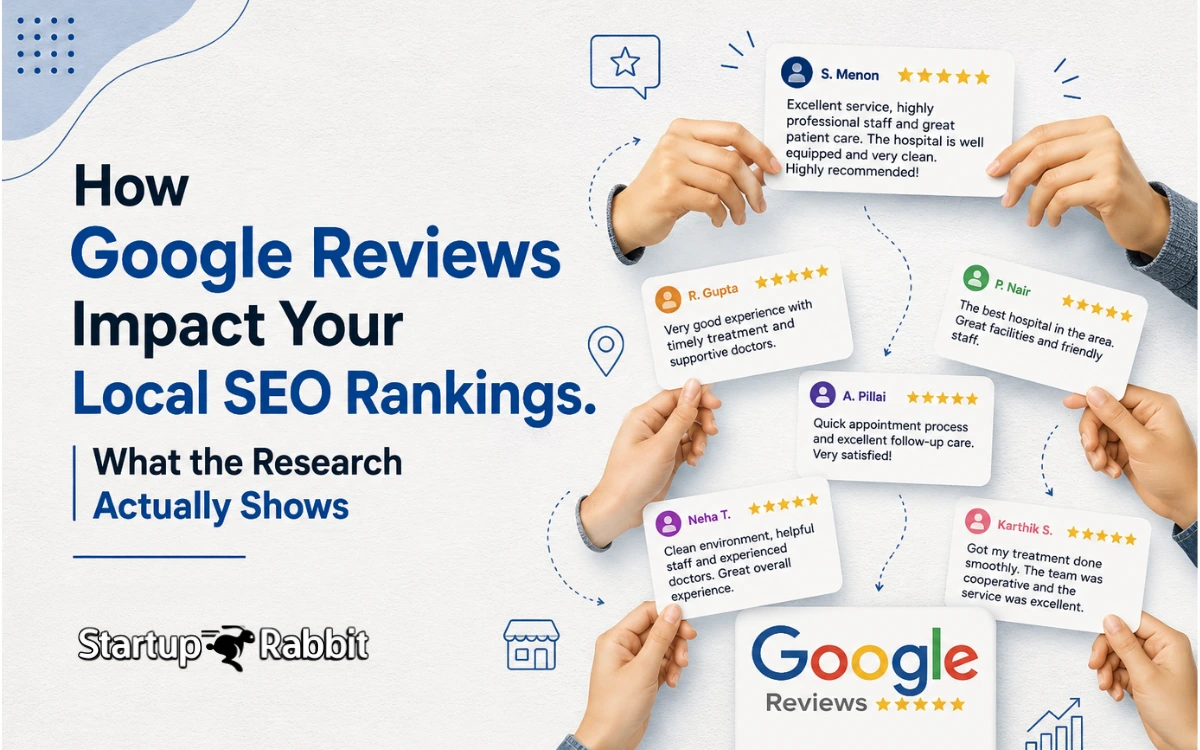
How Google Reviews Impact Your Local SEO Rankings. What the Research Actually Shows
Local search is the primary way small to medium sized businesses can be discovered today. Whether people near you search for the “best bakery nearby” or an “office loan provider in Mumbai”, Google Reviews are a significant element for what will appear in the Local Pack on Google and Google Maps. Do Google Reviews Help SEO? In a way that it is possible to track-or are reviews just another factor that builds trust for my customer? In this post, we will pull out some studies that touch upon how Google Reviews influence your local SEO. We will also share with you a framework on how you can build Google Reviews for maximum visibility, clicks, and trust.
Do Google Reviews Help SEO? Understanding the Basics
How Google Reviews Fit Into Local Search
Reviews have a significant impact on local search optimization, specifically through Google My Business. Google actually says that the amount, speed and diversity of a review are critical factor in rankings for their local pack. Google My Business impacts more than just the star rating. Google’s algorithm uses the content, sentiment and product/service specific terms used within the review. With consistent multiple positive reviews, and you’ll see businesses rise in the rankings, particularly in local search. This brings a dramatic surge in recent years with the rise of “near me” search queries.
Direct vs Indirect SEO Benefits of Reviews
Direct Benefits to SEO
- Improved local pack results
- Increased organic click through rates
- Improved conversion rates
- Increased brand searches
Indirect Benefits to SEO
- Increased User Generated content (UGC)
- Natural variation of keywords appears
- Improved user signals
- Enhanced social proof for local search ranking
Why Reviews Matter More for Local Businesses
Local intent depends on trust and context. For brick-and-mortar services and neighborhood providers, reviews are one of the clearest expressions of customer experience—so they matter more here than for broad, informational searches.
What Google Says About Reviews and Rankings
Google states reviews help with user understanding and improve local results. But it doesn’t publish a strict weight for reviews in ranking formulas. That ambiguity leaves room for testing and interpretation. But combined evidence from Google guidance and SEO case studies indicates reviews are a meaningful signal.
How Google Reviews Influence Local Search Visibility
1. Impact of the number of ratings and reviews: Ratings and reviews have an effect on an businesses’organic ctr for their listings in the Google Local Pack and in Maps, which showcases the top 3 results for a given search query.
2. Use the Local Pack: In order for the company to obtain more visibility, boost foot-traffic to their physical location, and create brand trustworthiness in their market, the company needs to consider ranking in the Local Pack for the products or services it supplies.
3. Mobile-ready: For those people browsing via their cellular phone for local products and services, the Local Pack optimizes for mobile consumers. As it is the majority of search engines and provide location-specific with mobile-friendly search engine results.
4. How do the reviews affect the click through rate CTR: In terms of generating a business click-through by possible prospects and customers, ratings and the number of customer opinions can make all the difference.
5. Consumer trust reviews: About 95 percent of customers analyze opinions prior to buying, and 93 p.c say that opinions impact buying choices.
6. Provide search engines: Use keyword-rich articles as testimonials, since Google evaluates your opinion content to determine appropriate search engine positions.
Google Business Profile Reviews and Their Role in Local SEO
Two significant factors that influence local SEO according to Google reviews are the volume of them and the time they send. In local SEO, like in all areas of Google’s search business, content is still king and needs to be relevant and up-to-date. Fresh reviews signal to both Google and potential consumers that your business is active. It improves its presence locally online. The more your Google Business Profile is reviewed, the more it will boost your business’s authority and credibility. This is also essential in local SEO. The higher your ratings, the larger your consumer base. The more recent the reviews and the higher number of reviews you have, the greater your authority and reliability will be. They make you approachable for both consumers and search engines. But it’s important to consider the content of the reviews.
Review Quantity vs Quality SEO – Which Matters More?
| Metric | Review Quantity Focus | Review Quality Focus |
| Primary Benefit | Higher search visibility and local prominence | Stronger consumer trust and better conversions |
| Revenue Impact | Up to 54% increase in revenue | Up to 28% increase in revenue |
| SEO Impact | Boosts keyword visibility and acts as a ranking factor | Improves click-through rates and supports E-E-A-T signals |
| Risk Factor | Sudden surges may trigger spam filters | Low volume can undermine credibility |
| Consumer Perception | Suggests a broad, established customer base | Ratings between 4.2 and 4.9 feel more authentic |
| Trust Threshold | At least 10 reviews needed for legitimacy | A minimum average of 4.0 stars is expected |
Finding the Right Balance Between Volume and Value
It’s all about a balance between the number of and the quality of the reviews that you receive to be the very best. For the best ranking places, you need to ensure that you not only accumulate several new reviews monthly but also that those reviews are relevant. Usually the first 3 position has around 4.1 stars rating and still got new reviews each month. So know your place in the search and build your strategy on that.
Common Misconceptions About Review Counts
1. Myth: You can’t get online reviews
You can get online reviews, and many customers do. Roughly 86% of customers are willing to leave a review after a purchase. Businesses can be proactive and ask for reviews, especially if a customer’s problem was resolved. The only trick is to ask for the review only after the customer has been able to try and experience the product/service for a certain time.
2. Myth: Customers don’t read online reviews
Of almost 4.7 billion internet users, over 72% use online reviews when making a purchase. Online reviews play a significant role in the consumers purchasing journey and with that, comes an aspect called ‘review velocity’. It serves as an information source for the customer and adds value to your brand’s description. Also, it improves your website’s SEO and increases sales and conversions.
3. Myth: Only 5-star reviews count
Customers can see it as ‘fake’ if your business has only positive reviews. Hence, they become suspicious. Getting mixed reviews, on the other hand, gives your business feedback that can help improve. In fact, the latest findings showed that most companies accept reviews to engage their customers and build trust.
4. Myth: only angry people leave reviews
Only roughly 25% of reviews are negative. The majority of reviews, roughly 75% are positive. The reason many unsatisfied customers write online reviews is to express their complaints and seek compensation or assistance from the company. The fact is that happy customers also write reviews, which generally highlight the positive aspects.
5. Myth: Online reviews aren’t real
It’s true some businesses still purchase fake reviews for promotion, but it’s less common than it once was. The majority of the online reviews available on Google, Yelp and other sites are still very authentic. Research showed that approximately 90% of all online reviews were genuine and people could quickly discern which reviews weren’t real.
Star Rating Google Maps SEO – Does Rating Score Affect Rankings?
How Average Ratings Influence User Trust
Positive reviews have the greatest influence on consumer trust, greatly outpacing branded websites, social media and paid ads (74%). This is because the reviews are written by other customers, not by the businesses themselves. Interestingly, 42% of consumers consider online reviews as legitimate as a personal recommendation. Also, 91% of 18–34–year–olds do. Successful businesses use this trust to their advantage and actively solicit feedback and reviews and put them to good use as a goalkeeping tool.
Why Higher Ratings Often Improve Conversion Rates
Positive reviews lead to more consumer activity: reviews cause consumers to be more likely to. Take actions such as:
- Book an appointment
- Buy something
- Fill out a contact form
The Difference Between Rankings and Customer Decisions
In competitive Map Packs, star ratings can make a huge difference in terms of user trust and ranking potential. Those businesses that receive ratings within the 4.0 to 4.7 range are most likely to perform well. While a low rating may lead to lower click-through and engagement. Any businesses receiving ongoing great feedback are better than 100% satisfied customer reviews for Google. This means that other factors such as engagement and trust signals can make the difference and ensure that businesses outrank others, even if they are in similar proximity.
Review Keywords Local SEO – Do Keywords in Reviews Matter?
How Google Understands Review Content
NLP allots every content in the reviews that there is from Google. It knows which place (or person and thing, but I’m focused on a local sense) the review belongs to. Also, what categories and characteristics extracts from the review to provide a better context of the location.
Location and Service Keywords in Customer Reviews
City name similarities exist in customer reviews as do similarity in the type of keywords utilized. Just like city names, there are similarities in what is said in the reviews, regarding their relevance to local search engines such as Google. They will help increase local search rankings, drive traffic into Google Maps and Local Pack, and create a sense of trust among potential clients. This also works with highly intent driven keywords, to increase relevance. In short, it is essential to make the most of local reviews in order to enhance local business presence and presence in search results.
Natural Mentions vs Keyword Manipulation
| Feature | Natural Mentions | Keyword Manipulation (Stuffing) |
| Approach | Writes for human readers first, ensuring the text flows smoothly when read aloud. | Writes for algorithms, repeating the exact phrase repetitively in every section. |
| Vocabulary | Uses synonyms, semantic variations, and related concepts to cover a topic comprehensively. | Forces exact-match keywords even if the sentence structure becomes jumbled or unprofessional. |
| Keyword Density | Focuses on context and topic integrity rather than hitting a specific mathematical percentage. | Fixates on an unnatural keyword percentage, often placing keywords in lists or out of context. |
| User Experience | Provides valuable information, improves readability, and keeps users engaged (reducing bounce rates). | Causes a negative user experience because the content sounds spammy and unnatural. |
| Search Engine Result | Builds long-term rankings and safely aligns with modern NLP (Natural Language Processing) and semantic search updates. | Results in search penalties, demoting the page’s position or removing it from indices entirely. |
Strengthening Relevance Through Authentic Feedback
Authentic feedback has the capacity to reinforce the value of learning and development by making it more relevant to where it is applied in their work. It is more than generic praising and assigning marks based on facts, issues, and emotions that would be a consequence in their work.
Review Response SEO Impact – Should Businesses Reply to Reviews?
Benefits of Responding to Positive Reviews
It’s mandatory to reply to both positive and negative customer reviews.
For example, if some pieces of savings instruments want the positive feedback, it is appreciated and makes for a better relationship.
Handling Negative Reviews Professionally
When it comes to negative reviews, however, showing signs of you’re accountable and willing to improve can actually earn more trust than many times having a positive review.
How Responses Improve Customer Trust
Having a professional response will improve your reputation and by extension tell Google that your business is responsive. A lot of contractors additionally include all of these reactions in a regimen consumer review marketing strategy to boost their effect.
Does Review Management Influence Rankings?
Yes, it is true that responding to reviews can positively affect local SEO; it shows that there are “active” businesses, boosts the site with refreshing content, enhances relevant keywords, and elevates the reader’s opinion.
Review Velocity Local SEO – Why Consistency Matters
What Is Review Velocity?
Review velocity, in simple terms, refers to how many and how quickly reviews posts to a business’s review profile. That is, it’s how fast the reviews change over time. For instance, a gaming cafe with 100 reviews per month has greater engagement than one that gets 100 reviews a year. This ongoing activity in the eyes of Google tells them the business remains healthy, active and continues to be relevant to customers.This constant activity creates trust and relevance in the eyes of Google.
Why Consistent Reviews Look More Natural
Implement a customer journey with review requests as part of it to maintain review velocity and “relevancy”. Idiots like to give a handful of honest reviews, rather than hundreds. Remind customers to leave positive reviews after great interactions. Feature easy connections to make reviews simple, and teach employees to ask for reviews. Also, provide QR codes on their receipts, etc. Requests can be evenly scheduled with the help of automation tools. Make sure that customers feel valuable, not forced, to create their odds of leaving reviews.
Risks of Sudden Review Spikes
Review spam is a method done by the bad guys or spammers and entails posting fake, misleading or manipulative reviews on-line. This fake-review strategy will cause unhelpful effects to a firm’s online reputation by sharing bad reviews of fake clients masquerading as clients and employees. These moments can be both positive or negative but neither is providing any real customer experience.
Creating Sustainable Review Generation Processes

Negative Reviews SEO Impact – Can Bad Reviews Hurt Rankings?
Understanding the Difference Between Rankings and Reputation
| Feature | Rankings | Reputation |
| Definition | A specific position on a list based on calculated metrics or algorithms. | The overall public perception, esteem, and trust earned over time. |
| Basis | Quantitative data, specific rules, scores, and formulas. | Qualitative feelings, experiences, reviews, and word-of-mouth. |
| Timeframe | Short-term; a snapshot that can change quickly with algorithm or data updates. | Long-term; takes years to build and is deeply ingrained. |
| Control | Often externally dictated by third-party evaluators, search engines, or grading agencies. | Internally driven by your actions, customer service, and ethical behavior. |
| Measurability | High; easily tracked with exact numbers (e.g., #1 on Google, 95/100 score). | Low; measured indirectly through sentiment analysis, surveys, and brand loyalty. |
How Negative Reviews Affect User Behaviour
Negative reviews have a profound effect on your online interactions and Google’s perception, as well as your future business. The fewer clicks more bounce rates, less time spent, which leads to fewer star ratings. This means it will go under Google’s interpretation that it is not useful and relevant content. Plus, if you go down in engagement, especially in calls and messages, then you are also negatively impacting your ranking. In this way, reviewing along with optimization for keywords and backlinks is not enough to create a powerful online impact and improve search engine rankings.
When Negative Feedback Can Become an Opportunity
Negative reviews really take a hit on your online business interaction and Google’s idea. Low star ratings result in a lower number of clicks, higher bounce rates, and less dwell time. All of which are seen as a lack of relevance by Google. Further, lower engagement metrics like calls and conversations can have a further adverse impact on your ranking. This means review needs to be dealt with alongside keyword optimization and backlinks to ensure a powerful online existence and higher search ranking.
Best Practices for Reputation Recovery
1. Promote positive reviews
- Encourage happy customers to share their experience.
2. Follow up emails to include review links.
- Put QR codes or posters in your Shop.
- Automate reviewing with review-request tools.
3. Fix recurring issues
- If two or more reviews are discussing the same thing. When, for example, there are such reviews as “slow service,” “rude staff,” start thinking of this issue today.
- The improvements your perform in your operations keep you more at the helm of your own search engine optimization.
4. Mark counterfeit or false reviews
- When you read fake comment which are obvious fake. This is malicious so you can flag it through Google “Flag as inappropriate”.
- Use supporting evidence – if applicable.
Social Proof and Its Effect on Local Search Ranking
For search engine optimization, you use social proof in order to help prove to the general public that your business is valid. These include trust indicators, such as the website having testimonials, reviews, social media presence, and user-submitted content, etc. These factors directly impact customer decisions, your business’s authority, and in turn your search engine ranking.
- Social proof generates trustworthiness, relevance, and credibility.
- Customer reviews bring in fresh content.
- User-generated content indirectly improves rankings through user-sharing, backlinks etc.
How Social Proof Supports Local SEO Efforts
- Google uses reviews as a component of its local search ranking algorithm, offering companies with good rankings and lots of positive reviews an advantage.
- The content within a review is very likely to include keywords, thus naturally improving search relevance.
- Responding to reviews both positive and negative-builds the customer’s trust and prompts other customers to interact with reviews and provide their own feedback.
Google Reviews vs Other Local Ranking Factors
| Ranking Factor | Description & Key Signals | Estimated Impact | Effort Required |
| Google Reviews | Quantity, quality (star rating), recency, and keywords within the review text. | High | High/Ongoing (Requires proactive customer outreach) |
| Google Business Profile (GBP) | Primary category, proximity, keyword-optimized business titles, and profile completeness. | High | Medium (Initial setup and infrequent updates) |
| On-Page SEO & Content | Local keywords in title tags, schema markup, and localized landing pages. | Medium-High | High (Requires ongoing website optimization) |
| Link Signals | Inbound backlinks from locally relevant websites and directories. | Medium | High (Requires digital PR and outreach) |
| Citation & NAP Signals | Consistency of your Business’s Name, Address, and Phone number across directory platforms. | Low-Medium | Low (Handled once, updated as needed) |
| Behavioral Signals | Click-through rates, calls, and direction requests directly on your Google listing. | Medium (Influenced heavily by reviews and ranking) | Ongoing |
Why Reviews Are Only One Piece of Local SEO
Although customer reviews make up around 20% to 25% of your local search ranking, this can only be a piece of the complete local search strategy. The top three factors for the Google Local Search algorithm are relevancy, proximity, and prominence. Reviews are the second component: prominence. However, you must have good foundations in relevance and distance, or no matter what a company has done on its website and with regards to reviews it will struggle.
How to Get More Google Reviews Without Violating Guidelines

Review Schema Markup and Its SEO Benefits
What Is Review Schema Markup?
Website owner can integrate Review Schema Markup into your web page, which is a piece of structured data markup. It help search engines comprehend your web page content while giving the user an overview of what the review-related information is.
Review Schema Markup SEO Benefits
1. Schema Markup optimizes content for better meaning and interpretation for machines (such as Google search engines). ML helps machine to match your content with the intent and relevance to user’s search.
2. Using connected schema markup for the schema app creates a reusable Content Knowledge Graph. It explains entities (things in your website) and their relations. This gives the machine (search engines) the knowledge about your company to connect to its knowledge.
3. Prepare for an AI-driven world; your websites and apps are getting intelligent with every passing second. Search engines like Google are becoming intelligent, and machine learning will play the core role in connecting right information to users’ searches.
4. You gain control when your business shows in the SERP. Many businesses can be a victim of inaccurate representation in search results due to misinterpretation by the algorithmic functions of a search engine.
5. With Schema Markup, your content can qualify for Rich Results. Search result listings that are visually rich in appearance with a star rating are a type of rich result which will stand out in Google Search Results.
Common Google Review Mistakes That Hurt Local SEO

Building a Long-Term Review Strategy for Local SEO Success
1. Start posting reviews: Staff members ask for feedback after positive experiences and follow-ups with emails and receipts send requests out to the right customers at the right times.
2. Optimize the Google Business Profile (GBP): Make sure that your name, phone number, and address is the same on your GBP listing. Use posts for important updates, high quality pictures of what your company is about, and be attentive to the questions that are coming from your audience.
3. Prompt for specifics: Give customers more specific guidelines and ask specific questions to help customers fill in some more information for you so that the reviews can be longer for your consumers.
4. Recycle Reviews: Post the positive feedback to social media and use reviews from your GBP and customers and post those on your website. The customer will gain a sense of what to expect from you by visiting you from multiple social sites.
5. Utilize automation: Rely on tools for managing customer reviews. Using an automation for sending out customer review request messages to your most satisfied customers is an easy way to collect a lot more customer feedback.
6. Interact with feedback: Respond to every positive, as well as negative customer review. Make sure that if customers have given a negative customer response to anything, you address the feedback you can improve.
Conclusion
So, Do Google Reviews Help SEO? In a nutshell: yes. Reviews do play an important role for SEO. There is a great deal of evidence to recommend that they are in charge of both direct and indirect indicators/ Direct indicators are related to significance as well as visibility. Whereas, indirect impacts are related to improved interaction and conversion rates. For your small to medium sized firm, the importance of getting reviews can’t be dismissed. Reviews impact how clients understand your business and also influence decisions about whether to click your search listing. It is the blend of building an ideal Google Business Profile and providing the best possible customer service. It creates your review structure as a natural part of your overall local SEO strategy. You’ll experience the real benefits of customer reviews in the form of increased visibility, website traffic, and trust.
FAQs
Yes, Google Reviews positively affect Local SEO directly.
Google measures both review count, rating, and recency as a combined measurement versus your competition.
Yes, reviews with keywords can have a positive effect on Local SEO.
Yes, your Google review responses affect your Local Search Rankings.
Yes, negative Google Reviews can destroy your Local SEO – both through a direct penalty from Google, and also indirect damage by dissuading potential customers.
The only way to get more Google reviews legally is by simply asking your customers who have a positive experience to leave you a Google review. These reviews should abide by Google’s anti-spam and anti-incentive guidelines.
How to Use an SEO Directory the Right Way Without Harming Your Google Rankings
If a few might call SEO directory an antiquated aspect of modern local SEO, then by all means, there’s certainly still ground to cover in the search engine ranking visibility arena, provided you choose wisely. Modern search engines reward up-to-date business information, a trustworthy number of citations, and an amazing customer experience. Submitting to just any directory with a low-quality, high-quantity strategy can seriously hurt you and affect your ROI. Read everything you need to know about an SEO directory, and how modern search engines view directory links in 2026. Also, find out actionable low-risk ways to leverage directories without setting off warning sirens. We’ll cover step-by-step best practices, a section of India-specific examples, and even a checklist to keep you on track. So lets begin
What Is an SEO Directory?
Understanding Online Business Directories
An SEO directory is very much like any other business directories or business listing. Whereby, there is the listing of businesses within that directory. The web directory SEO journal covers different subjects under different sections of topic and it functions as an engine for you to search. Wikipedia and YouTube, for example, are considered a type of directory. The Google Adwords program will generate a specific ad for your keyword to your business should it appear on your list and it is more likely that you’ll be sure to get a large amount of traffic and earn some easy money.
How SEO Directories Have Evolved Over the Years
Over time from the early 2000’s, the importance of the SEO directories and submissions to boost link-building has declined significantly. Businesses would submit their website links to as many directories as possible to increase their website’s authority. However, with the continuous changes of Google’s algorithm in order to reduce the ranking of poor-quality sites, Google’s Penguin and Panda algorithm started penalizing low-quality directory sites. By 2014, Google focused on the NAP consistency and user engagement. Local Pack & Map has pushed the SEO practices away from just submitting to directories, and instead more emphasis is placed on high-quality relevant listings.
Difference Between Modern Directories and Old Link Farms
| Feature | Modern Directories | Old Link Farms |
| Editorial Oversight | Listings are manually reviewed to ensure accuracy, quality, and relevance before publication. | Submissions are mostly automated, allowing almost anyone to be listed without quality checks. |
| User Value | Organized into logical categories with helpful descriptions, making it easier for users to find businesses or services. | Provides little to no value for users, with pages often filled with auto-generated content or endless lists of links. |
| Business Verification | Helps search engines verify NAP (Name, Address, Phone Number) consistency, improving local SEO trust and credibility. | Does not verify business information and offers no SEO trust signals. |
| Focus | Usually niche-specific (such as medical or legal directories) or well-established general business directories with strict listing standards. | Accepts random URLs without relevance, creating low-quality collections of unrelated websites. |
| Purpose | Designed to help users discover reliable businesses while supporting local search visibility. | Created mainly to manipulate search engine rankings by passing link authority. |
| Linking Practices | Uses natural, relevant, and editorially approved links. | Operates through artificial cross-linking networks to inflate website authority. |
| SEO Impact | Can improve online visibility, local SEO, and business credibility when listed in reputable directories. | Can harm website rankings, as search engines like Google penalize websites involved in link farm schemes. |
Why Businesses Still Use Directory Listings
There are several benefits for listed businesses in directories: improve searchability, enable customers to locate businesses and services locally. It provides citation signals to the search engines and also a platform to review their service or product. For many small businesses, directory submission are still among the simplest, most affordable ways to generate business awareness and create consumer trust.
Does an SEO Directory Still Help Rankings in 2026?

Directory Listing Local SEO – Why It Matters for Businesses
Citation Building SEO and Its Connection to Directories
What Is Citation Building?
Citation building, or the practice of getting your business listed in many online directories and listing sites, involves getting your Name, Address, and Phone Number (NAP) and Website URL added to each listing. These online directories and listing sites are Yelp, Yellow Pages, Google My Business.
Structured Citation SEO Explained
Most of these are considered structured citations. These are sites where business information is organized in a structured format. Sites like this will not only give a user the opportunity to search for company information, but to also review it and rank it higher in searches. Common structured citation sites that most of you will be familiar with include:
- Apple Maps
- Foursquare
- Google Maps
- Google My Business
- Yellow Pages
- Yelp
How Consistent NAP Information Strengthens Local Rankings
In order to avoid hurting your reputation and search engines seeing you differently, the NAP should be exactly the same on each site you submit your business to. In order to maximize visibility on local searches and not hurt your website, even slight inconsistencies in your NAP on these listing sites could impact how well your website ranks. If you recently re-branded and/or moved locations, it will be critical that you change and update the citation data on these and similar sites. This is how your digital identity will be recognized.
Citation Quality vs Citation Quantity
Citation Quality and Citation Quantity refer to two different yet intertwined metrics used to quantify the academic impact of an article or researcher. Quantity measures the number of references made to the publication; quality measures the substance, importance, and appropriateness of the citation itself.
Local Business Directory India – Which Listings Matter Most?
1. Exportersindia is a leading Indian B2B Marketplace targeting the whole universe of manufacturers, suppliers & exporters. Similar for the targeted demographic across various niches is Bizz Duniya. Business with India is built upon two decades of bringing companies together in a business environment rooted in trust.
2. AskLaila has a unique feature: it blends the familiar classified format with local search capabilities. This is good for any company targeting consumers. Local-Listing encourages users to post listings across several categories for free, whereas AltaIndia offers a large database of registered businesses targeting buyers.
3. The Gujarat Industries Directory, is as expected a regional guide for the businesses in Gujarat. This also represents the concept that niche and regional directories may even perform better as they deliver leads to specific markets.
JustDial Sulekha SEO India – Do These Directories Help?
Justdial and Sulekha are two prominent online business directories offering distinct strengths for diverse business needs.
Justdial’s outstanding SEO and user friendly experience encourage it to drive search engine results and capture organic visitors while its massive database promotes sustained engagement that supports higher conversion rates.
Meanwhile Sulekha supports its emphasis on localized offerings and consumer decision speed with customized recommendations, which contribute to rapid lead acquisition.
Whereas Justdial leads the market when it comes to leads and the size of the customer base, Sulekha’s niche listings support service-focused businesses’ efforts to reach new local customers.
Each business must consider its specific objectives around SEO, user retention, and leads capture to decide the best approach for its online development.
Online Directory Submission India – Best Practices for SEO
1. Consistency with NAP: Having the same Name, Address, and Phone number across directories is a vital local SEO ranking factor, since conflicting information will be bad for search ranking and sends mixed signals to Google.
2. Backlink Profile: Boost your backlink profile by building 30-50 relevant directory links; it will have an effect on the total link health, but on directory links individually the effect is minimal.
3. Visibility: Directories act as a discoverable place for high-intent referral traffic, so your business has the potential to grab the existing demand.
4. Trust Signals: List on trusted websites like BBB, Trustpilot to boost trust and Authority of the listing, for both potential customers and search engines.
High DA Directories India – How to Identify Quality Opportunities
Make use of pages that has DA 50+, you may have to check out these stats with the SEO tools. It’s better for you to prioritize directories that specifically focus on your industry and location rather than a wide range of industries. Google favors context and relevance more than broad and non-relevant directories. Steer clear of “instant approval” automated directories. If a directory maintains strong editorial guidelines, that is an excellent sign of a good website. Do check to see whether that directory gets organic traffic and whether they are using HTTPS. Do not go for directories that are made just for linking building. If you find a page linking to hundreds of irrelevant or spammy sites do not choose it.
Niche Directory SEO Value for Industry-Specific Businesses
Healthcare directories: Patients who want reliable providers rely on listing. Contact details such as name, specialization, preferences, insurance details, hours and a link to booking. Plus individual qualifications and patient ratings, are key to continued patient trust.
Legal Directories: Client seeking legal aid get them. Best profiles include practice areas, city locations, attorney names, experience, best contact methods, whether free consultation offered and reviews of current/future clients. Access is best gained by being specific.
Restaurant Listings: Customers search for restaurants by area and type of food. Listings should include restaurant name, cuisine, menu photos, hours of operation, reservation links, delivery options, customer reviews. Also, keep content updated.
Directories for the property market: Users purchasing, selling or letting find help. Profiles need name, coverage, property type, contact details, listings, references and experience. Locality is essential.
Home Services Directories: Users seek services such as domestic contractor, electrician, plumber. Directory listings need business name, category, emergency or not, available services, contact info, pictures and reviews. Specific service description is vital to enhance effectiveness.
Agency Directories: Used by marketing, and creative agencies. Profiles must detail the agency name, services offered, niches served, quotes from users, case studies, number of employees and contact forms. Niche directories work well at drawing in decision makers.
Dofollow Directory Links – Should You Focus on Them?
Understanding Dofollow and Nofollow Links
Dofollow links serve to pass authority and influence rankings and have no special attributes that tell SEO-innies not to adhere to the same methodology.
Nofollow links, however, have an attribute (rel=”nofollow”) that cues SEO-innies to not follow the same rules and pass ranking influence.
Why Link Quality Matters More Than Link Attributes
A few links from authoritative sites with meaningful content will have a greater effect than dozens of low-quality links. Only looking at volume can harm your web optimization.
The Risk of Chasing Links Instead of Visibility
Not all desirable links are dofollow links. Going against UGC, nofollow or sponsored links can result in a less natural backlink profile while potentially missing out on traffic and exposure.
Building a Natural Local SEO Profile
Having a healthy backlink profile should be a combination of dofollow and nofollow links, as website gains them naturally. Search engines will prefer a variety of links as it makes them less likely to assume that they’re suspecting spam. A well-constructed profile has the following features:
- A balanced mix of dofollow and nofollow links.
- inks from different pertinent and credible sources.
- Descriptive anchor text (not overly “keyword dense”).
- Step-by-step links being added (not all at once).
Business Directory Ranking Impact – What Really Influences SEO?
- Consistent NAP: Get the same business Name, Address, and Phone details for your company on 15-20 quality directories. This is important for search rankings.
- Rating & recency of reviews: Real, current reviews prove your business is operational, relevant, and relevant enough to rate (and review).
- Full profile information: The more detailed information, such as your hours, services, pictures, and business category, is available and correctly input into your profile. It has a higher chance of making your profile clickable.
- Authority of directory: A link from a high-authority, industry-related directory can be worth as much as five times more for rankings compared to a low-authority directory listing.
- Engagement signals: People are actively interacting with your listing by visiting, calling, or sending a request. This shows a signal of intent.
Common SEO Directory Mistakes That Can Harm Rankings
How to Create an Effective Directory SEO Strategy
Step 1. Lock-in URL structure & site architecture: whether you create URLs and site structure in a way which could cause you issues. It would cost you your rankings for long term to be aware of site structure that impacts. The structure should be shallow, with a max of 3 levels and it should include a descriptive slug including target keywords.
Step 2. Use Schema Markup: Use schema markup in order to help search engines understand the page. Schema markup helps you achieve rich results which will benefit your search rankings. In order to use schema markup for directory listings you should utilize LocalBusiness and Review schema for the directories and the page. Utilize ItemList for categories of directories and BreadcrumbList for all of your pages.
Step 3. Optimize On-page Elements: Combat thin content by setting a rule to use a unique description for each directory listing. It ensures a proper header structure, alongside optimized meta titles and meta descriptions optimized for a desired keyword phrase.
Step 4. Technical SEO and Speed: How do we limit file size on images and use good cache strategies and have slimmed code, files and pages.
Most searches for directories are now made on smartphones, so take that into account and optimize for mobile devices, too.
Step 5. Earn off-page authority: The best off-page authority builder technique isgettinghigh-quality backlinks. This might mean spying on competitors and also getting backlinks from them. Keep your NAP information similar everywhere.
Step 6. Regularly Review: You must keep an eye on Google Analytics and Google Search Console to detect any kinds of issues or optimize your traffic sources.
SEO Directory vs Google Business Profile – Which Is More Important?
| Business Situation | SEO Directory Listings | Google Business Profile (GBP) | Which Is More Important? | Why It Matters |
| New local business that needs calls quickly | Helps build consistent business citations across directories, but results usually take longer. | Appears in Google Maps and local search, making it easier for customers to call, visit, or request directions. | Google Business Profile | GBP can drive faster local visibility and customer inquiries through maps, reviews, and business information. |
| Business focused on long-term organic growth | Strengthens local SEO by improving citation consistency and supporting your backlink profile. | Supports local search visibility but has a limited impact beyond local intent. | SEO Directory Listings | Directory listings contribute to stronger local SEO signals and complement your website’s long-term search performance. |
| Service-area business without a physical storefront | Builds trust through consistent business information across multiple directories. | Helps you appear in local searches for service areas, even without a walk-in location. | Both | Directory listings improve credibility, while GBP increases visibility for nearby customers searching for services. |
| Business operating in a highly competitive market | Reinforces authority through quality citations and local SEO signals. | Improves visibility in Google Maps and the Local Pack where competition is highest. | Both | Strong directory listings combined with a well-optimized GBP improve your chances of outperforming competitors. |
| Business looking to improve credibility and local trust | Increases online presence by listing your business across trusted directories. | Builds customer confidence with reviews, photos, ratings, and updated business details. | Google Business Profile | Customer reviews and an active GBP often influence buying decisions more than directory listings alone. |
Future of Directory SEO and Local Search
- The way people query directories will shift to resemble how they express the desire for local services, rather than how they phrase search queries.
- Hyper-locality will become a much bigger factor with consumers expecting localized results around a specific neighborhood, landmark or service area rather than a city wide listing.
- We anticipate artificial intelligence (AI) and personalization becoming increasingly significant as directories evolve. It become more tailored to a user’s intentions and context, as well as past behavior.
- Directory users will continue to expect speed, ease of navigation, and mapped search. Also, it includes content such as images and videos that quickly answer a directory searcher’s queries about a particular local business.
- Future directories will serve as key conversion platforms where local users are connected to phone calls, bookings, messages and even the opportunity for social commerce.
- For local businesses, maintaining consistency for your NAP in directory profiles, accumulating relevant and authentic customer reviews, and posting location-specific content while treating every directory listings. It is like its own small landing page and will be the most effective way to leverage directory search.
Conclusion
SEO directory, if used effectively, can serve as a helpful component of a local SEO strategy. It is essential to select and optimize well in the first place and be mindful of its best usage. Look for relevance, good NAP consistency, natural business descriptions, good reputation for the website you’re building a citation for and choose quality portals as opposed to trying to land follow-links or a bulk submission to directory sites. Keep it in balance with having an optimized Google Business Profile, producing relevant local content, and taking good care of local reviews. It generates reliable referral traffic and bolsters your local search signals without the need to fear penalizations. Use the SEO directory as a layer to confirm your location as well as establish your online visibility without as a shortcut to the top results. This way, you can boost your citations and directory listings.
FAQs
SEO directory is an online site that categorizes sites and companies by an area of interest such as niche, business type, industry, or geography (similar to the yellow pages online).
Yes, directory submissions still assist SEO, but it no longer plays such an active role as it once did in many SEO campaigns. Today, it is the greatest service for local search, creating brand authority and building trust as opposed to a large quantity of backlinks to game the system.
You can classify the finest Local Indian business directories on the basis of particular use such as: General Local search, Local Business to Consumer(B2C), and Local B2B Wholesale.
Most of the organizations we work with require anything from 15 to 50 highly targeted quality listings.
Yes, Dofollow directory links are really crucial for passing the link authority of the directory site As theyl assist in enhancing your domain authority and also your Google rating on your site.
Yes, directories containing many low quality and spammy links can be extremely damaging for your ranking in the search engines.
What Does a Digital Marketing Strategist Do And Does Your Business Actually Need One?
Digital marketing strategist is a person defining the whole strategy on how to use marketing to grow business. They do not just manage and execute single marketing campaigns, but rather connect the goals of the business, insights of customers and knowledge of channels to form a solid plan. This enables lead generation, customer conversions and building of brand value. The right strategy for a company ranging from startups to established businesses would minimize ad spending, make better choices about the appropriate channels, and build a repeatable marketing cycle for growth. This blog will help you understand who a digital marketing strategist is, why this job role is important – especially in India – and if you need one. Read the blog to understand the job responsibilities of this position, skills you need when hiring, and errors companies tend to make without this strategic approach. Furthermore, find out the various ways in which you could acquire strategic marketing guidance.
Who Is a Digital Marketing Strategist?
Understanding the Role Beyond Marketing Execution
A digital marketing strategist plans and develops all of a business’s digital marketing strategies. These strategies help.a company gain customers ormarket awareness to achieve goals. Needless to say digital marketing can implement across channels. But all channel specific digital marketing initiatives fall in line with a greater marketing strategy.
How Strategists Connect Business Goals With Marketing Activities
Digital marketing strategists don’t just work to make digital marketing strategies work; they implement what they plan. A strategist will look to convert the business goals into a series of marketing strategies. They state why and where specific experiments should be run and what types of messages to use for certain groups.
Difference Between a Marketer and a Marketing Strategist
| Aspect | Marketer | Marketing Strategist |
| Primary Role | Focuses on executing marketing strategies through campaigns and day-to-day activities. | Focuses on long-term business growth, market positioning, and overall marketing strategy. |
| Main Objective | Implements the roadmap to drive engagement, leads, and sales. | Creates a roadmap to help the business achieve its long-term goals and stay ahead of competitors. |
| Key Responsibilities | Manages SEO, paid advertising, email marketing, social media, content creation, and campaign execution. | Analyzes market trends, identifies target audiences, defines brand positioning, and designs the sales funnel. |
| Focus Area | Daily marketing execution, campaign performance, lead generation, and content management. | Strategic planning, business objectives, market research, and competitive analysis. |
| Decision Making | Decides how to execute campaigns based on the strategy. | Determines what marketing approach the business should follow. |
| Typical Question | “What content should we publish this week, and how many leads did our latest campaign generate?” | “Who is buying from us right now, and how do we reach the next customer before our competitors do?” |
| Time Horizon | Short-term campaign execution and ongoing optimization. | Long-term planning and business growth. |
| Success Metrics | Website traffic, leads, conversions, campaign ROI, engagement, and sales performance. | Brand positioning, market share, customer acquisition strategy, and overall business growth. |
| Primary Skills | Content marketing, SEO, PPC, email marketing, social media management, analytics, and campaign management. | Strategic thinking, market analysis, business planning, customer research, and competitive intelligence. |
| Overall Contribution | Executes the strategy effectively to achieve measurable marketing results. | Builds the marketing strategy that guides the business toward sustainable growth. |
Why Strategic Planning Matters for Business Growth
They map the customer’s journey towards specific goals that align with business results and determine what experiments need to run and in which order. Also, the budget needed to invest to meet a specified target.
In other words, a strategist ensures that every campaign will lead to profit and growth.
What Does a Digital Marketing Strategist Actually Do?
- Audience Understanding: A digital marketer is able to develop the understanding of their customers in terms of behavior as they know the current and target audiences by developing profiles.
- Channel strategy: It is very useful for the digital marketing strategist to identify specific channels for specific purposes from all possible choices of search engines, social networks or e-mails.
- SEO and content strategy: The strategist works to utilize knowledge of overarching marketing objectives to further promote website visibility and engaging content on search engines that appeals to the preferences and demands of its target audience.
- Campaign design and delivery: Experts create and execute marketing campaigns – on product and service, new seasonal or in time for the holiday – to deliver on desired results and marketing goals.
- KPI monitoring: Through performance measurement in terms of KPI’s strategists use analysis in terms of data to enhance their strategies.
- Team leadership: The team must include strategists who work with graphic artists, copyrighters etc to execute strategies that are both innovative and results-oriented.
Key Marketing Strategist Skills Required for Success
- Data Analysis: It is important to actually have a look and comprehend data. Researchers check reports, record and make discoveries for sample trends.
- Communication: Using clear wording and conveying messages simply are essentials for people working in communication roles. You want to make sure your team’s ideas get across without any complications.
- Technical knowledge: The teams here know all the tips and tricks for operating and handling digital platforms and tools.
- Strategic thinking: Everyone on the team knows the bigger picture and outlines a plan in which every member can pursue the common goals of the team and the organization.
- Creativity: Digital marketers bring the sparks of ideas to life. Designers conceptualise, then create campaigns, with an aim of snagging attention.
- Adaptability: These professionals observe how things change on the internet and keep up to date with the trends.
How a Digital Marketing Strategy India Businesses Need Differs From Global Markets
1. Understanding Regional Consumer Behaviour: The digital marketers in India have customized their marketing in regional languages and cultures.
2. The audience inclination on the platforms: Indians prefer investing time into social media like Instagram, WhatsApp and YouTube rather than investing in professional networking platforms like LinkedIn, which is used across the globe.
3. Budget Allocation for Indian Businesses: The majority of businesses in India focus on the cost-effective approach through digital marketing. SEO and Social Media Marketing are one of the few areas where businesses get visible outcomes and good ROI.
4. Content Style and Messaging: Digital marketers here emphasize on storytelling and an emotional connect in their marketing. They bring out content that build up trust among the target customers and make them feel relateable.
5. Adoption of Digital Marketing Trends: Businesses in India quickly adopt AI and Automation trends with adaptations for regional usage. Thus, businesses need to have awareness of such latest digital marketing trends to sustain the competition.
6. Local SEO and Regional Marketing Considerations: Local search and optimisation of Google Business Profile, along with regional keywords can help local retail stores, SMEs etc connect with the local people.
The Role of a Growth Marketing Strategist in Scaling Businesses
- Market and Competitor Research: Here marketers do the overall research of the market. This includes the industry, trends, customer behavior, and what the other players are doing. That way, they can identify where there are new opportunities.
- Strategic Roadmapping For Progress: The next step involves crafting definitive plans that would lead the business smoothly through the scaling stages.
- Customer Acquisition & Retention Strategy: This step entails coming up with techniques on how to win new customers and maintain the current ones’ loyalty.
- Revenue Model Optimization: In parallel, they optimize existing revenue models, including pricing, sales channel, and sources of income.
- Process Improvement and operational efficiency: Meanwhile they also eliminate constraints and optimize the workflows for easy implementation.
- Brand Positioning & Growth opportunities: Moreover, fine tuning your brand message and pursuing potential market entry and expansions that match our strengths.
- Performance Tracking & KPI Execution: Last but not the least, they would set in place a tracking mechanism that would monitor the success of all the strategies and plans they put in place by measuring the key performance indicators (KPIs).
Brand Strategy Digital Marketing – Why Both Must Work Together
1. Brand awareness & Recognition: Digital marketing offers you a strong chance to increase awareness and recognition of your brand in various media channels with clear & unified brand messages.
2. Creates Customer Loyalty and Retention: This cohesive branding strategy will create an emotional connection with the brand creating loyalty and making it stand out from the rest. Consistent delivery of brand messaging, day after day via marketing programs builds connection.
3. Develop trust and Credibility: A well-thought & consistent branding across your entire digital marketing activity builds customer’s faith and credibility and provides reliability. They believe in you to get services/ products that meet expectations.
4. Enhances efficiency of marketing & Increases ROI: Increased targeted advertising by the integrated branding of campaign activities improves the overall marketing efficiency. It also improves the efficiency of various campaigns, which is part to the ROI. In simpler words, higher efficiency leads to higher Return on Investment of the campaigns.
5. Can be Scaled up by Brands Across Channel: A strong foundation laid down will make the brands reach much further across the channel i.e. Social media, PPC, SEO, and email marketing etc. All this efficiency gained will become an easy path for newer channels in the future.
How a Digital Marketing Strategist Builds an Integrated Marketing Strategy
1. Keyword Optimization: SEO is a long-term process, and PPC helps in finding effective keywords within a shorter period. You will be able to view the keyword(s) that is/are converting with the running PPC ads. This will help inform your SEO campaigns.
2. SEO & PPC Synergy: Research has demonstrated that the synergies between SEO and PPC campaigns are significantly higher when both are collectively employed. Collectively it’s a synergy that boosts the overall marketing efficacy.
3. Link Building & Content Sharing: get high-quality Backlinks to help build a better domain authority. More backlinks will mean more Social media and email marketing has become effective.
4. Personalization: An email marketing campaign personalizing messages, in particular, helps to “capture” the visitor’s e-mail for further communication. This also helps to create retargeting lists for custom ads.
5. Building Brand Awareness: By boosting the social media presence, brand awareness is increased. When a customer becomes familiar with a brand, they may be more inclined to look for it later which can improve PPC and SEO results.
6. Content optimization: The experimentation and content optimization. You are capable of drawing useful conclusions that can inform your website content. Thereby improve the engagement and conversion rates for all of your digital marketing actions.
Digital Marketing Roadmap – From Planning to Execution
Step 1: Develop SMART Business and Revenue Goals
Decide where to focus (lead generation, brand awareness, sales) and then identify ways to measure your success.
Step 2: Assess your digital landscape
Take a critical look at your website’s performance, SEO efforts, PPC results, social media engagement and lead tracking process.
Step 3: Select the optimum mix of channels
Concentrate your efforts on marketing channels, based on purchase intent, length of sale and competitiveness.
Step 4: Develop a content strategy road-map
Your strategy must cover the stages of the buyer journey and align with SEO objectives. It allow you to generate useful lead nurturing content.
Step 5: Combine marketing and sales
You need to track, qualify and follow-up leads quickly with automation.
Step 6: Develop a quarterly digital marketing roadmap
It may be more manageable to concentrate on your goals quarter-on-quarter, in order to adapt more rapidly to changes in your environment.
Step 7: Monitor key performance indicators and optimize
Keep an eye on what your performance indicators say, and use that data to develop your strategy.
Marketing Strategy for Startups India – Common Challenges and Solutions
1. Low Budget and Resources
Problem: In startups there are less funds to be spent in marketing campaigns. The entrepreneur usually spends more money and efforts on product development, business and operations. Because of that, promotional efforts on digital marketing are minimal.
Solution: Adopt cost-effective strategies such as search engine optimization (SEO) and e-mail marketing. Free marketing tools like Google Analytics and Mailchimp, working with agencies without initial costs could be other solutions.
2. Absence of a clear Strategy
Problem: There is no defined digital marketing strategy. Many startups do digital marketing in a way that does not lead to any conversion rate.
Solution: Set SMART goals and have content calendars. Keep track of KPIs such as lead generation, conversion rate, etc. And work with digital marketing agencies to have proper strategy.
3. Strong Competition
Problem: Highly competitive marketplace for startups in India to grow and survive against the high-funded brands in order to survive.
Solution: Build emotional relationship with the target audience by focusing on telling stories & customized marketing strategies. Use SEO to get higher brand visibility over a period and consult an agency such as Startup Rabbit to find out niche solutions.
4. Swiftly changing Trends
Problem: Startups often fail to understand new digital marketing trends and the ever changing customer buying patterns.
Solution: Get insights by subscribing to marketing blogs and newsletters. Assign a dedicated resource for tracking trend or hire specific marketing agency and take the plunge to test smaller campaigns.
Performance Marketing Strategist vs Digital Marketing Strategist

Marketing Consultant India vs Full-Time Digital Marketing Strategist

Fractional CMO India – An Alternative for Growing Companies
What Is a Fractional CMO?
A Fractional CMO is an experienced marketing executive that companies can hire part time or on a contract basis for marketing guidance and expertise for only a fraction of the cost of a full time CMO.
How It Differs From a Marketing Strategist
A Fractional CMO joins your team and integrates as part-time executive leader focused on developing the long term strategy, owns marketing results, and takes on managing your internal resources or agency. In comparison to a Marketing Strategist (or consultant), who works with you to identify the problem, designs a specific marketing plan till completetion of project. After which they act as an external, temporary advisor.
Benefits for Startups and SMEs
1. Save money on cost. Companies can save more money compared to hiring a full-time executive as it saves the hassle of salary plus other benefits.
2. Flexibility. It will enable businesses to gain from this expertise and support on part-time basis without needing a full-time professional.
3. Objectivity and Fresh Perspective. A Fractional CMO will also give unbiased analysis of the company and will help to make improve and be more strategic.
4. Unique skills and experience. Due to experience in all aspects of marketing, they would not be stuck to a particular process, but would know all of the possible options and have a working knowledge of them to develop a working plan.
5. Specialist network. As a fractional CMO you can use my vast network of experts in every area of marketing. This saves companies time.
6. Reduce the work pressure and work of the team. Managing your brand’s strategy, and even budget for that matter, can be extremely taxing and this could be avoided with the help of a professional.
7. Be strategic. As the CMO will analyze the company and the market situation and advise accordingly on marketing strategy.
8. Achieve tangible results. Our team is a results-oriented team and help businesses grow in all the sectors of the market.
When Businesses Should Consider a Fractional Leadership Role

Common Mistakes Businesses Make Without a Marketing Strategy
1. Targeting the Wrong Audience
Mistake: Lack of data on ideal customer-Businesses think they know their perfect customer but do not. Marketing spent in the wrong direction.
How to Avoid: Existing research will inform your decision making process. Database research, surveys, focus groups, and competitor research are some points of great importance. Clarify your targets using demographics, and learn how to refocus your business by using behavior instead of input data.
2. Ignoring Competitor Analysis
Mistake: Not considering that the information presented internally is only part of the puzzle, as there is important information that competitors are offering as well. It is a mistake when the strategy is limited to the internal market.
How to Avoid: Conduct market and competitor research. What other services do you know of that have much the same service offering as you, or as similar maybe, what are they priced with, how are they advertise and what type of comments made by their customers.
3. Dependence of Assumptions over Data
Mistake: Assuming what consumers want without first doing proper research can result in creating a product that is not necessary and is not fit.
How to avoid it: Rely on data from survey statistics, and market reports for your strategic decisions. Design mini-test programs on emerging trends and also make sure to track trends on an ongoing basis.
4. Launching Before You Test Market
Mistake: This can lead to selling an idea no one wanted anyway.
How to avoid it: Test via beta testing, market feedback and A/B testing your marketing efforts. You can run a pre-launch test to make your product or service better before it’s on the market.
Future Trends Shaping Digital Marketing Strategy
1. Personalization At Scale: Many companies are now using AI to give the customers personal product suggestions and an immersive shopping experience. They use it based on past purchase behavior or data, like how Amazon recommends us a particular type of book or dress.
2. Optimization for Voice Search: If we use our smart speakers more than ever before for searching for products, how is the business going to tap that market? They need to restructure their content according to the voice queries, using natural language and voice keywords.
3. Rise of Video Marketing: From TikTok and Instagram short videos, all have one agenda to engage and entertain more to the younger crowd. Videos can make it easier for customers to shop through interactivity features as they will provide a direct link between the content and the purchase.
4. Privacy-Centric Ads: It is high time to become transparent with the usage of customers data as there is increasing awareness about privacy. The EU GDPR policy and elimination of third-party cookies has pushed for these strategies.
5. Immersive Experience With AR & VR: IKEA is using apps in Augmented and Virtual Reality which helps its customers to virtually check the furniture at their home to check its suitability for space. AR & VR help to better engage and increase the purchase likelihood.
Conclusion
A digital marketing strategist bridges business goals and marketing channels that can achieve those goals. They employs data, measurement, analysis and creative thinking to help their clients realize predictable growth and positive ROIs. In India, there are varied types of consumers and social media usage behaviours. Hence, a local digital strategist can leverage the available resources cost-effectively. For small-sized companies, it may be prudent to hire a digital marketing consultant or a fractional Chief Marketing Officer before eventually scaling up to a full-time digital marketing strategist. Looking for satisfactory results from your current marketing activities, or need a structured way to grow your business, a digital marketing strategist would be a worthy investment.
FAQs
The digital marketing strategist conceives and manages data-driven online campaigns that promote a business and boost leads and ROI.
A digital marketer carries out campaign plans while the digital marketing strategist draws the general business map and defines goals for the campaign.
They combines strategic planning, analysis and cross channel execution.
Yes, startups are in high need of a digital marketing strategist.
A marketing strategist develops high-level strategic, long-term objectives and overall vision for growing a business. Whereas a marketing consultant analyzes individual marketing campaigns, diagnosing problems and making practical, authoritative suggestions on how to address them efficiently.
The cost of hiring a digital marketing strategist can fall anywhere between $50 and $250 per hour for independent strategists.
Yes, your ROI will be massively improved if you hire a digital marketing strategist who can remove guess-work, make optimum use of your marketing budget, and improve your customer journey.