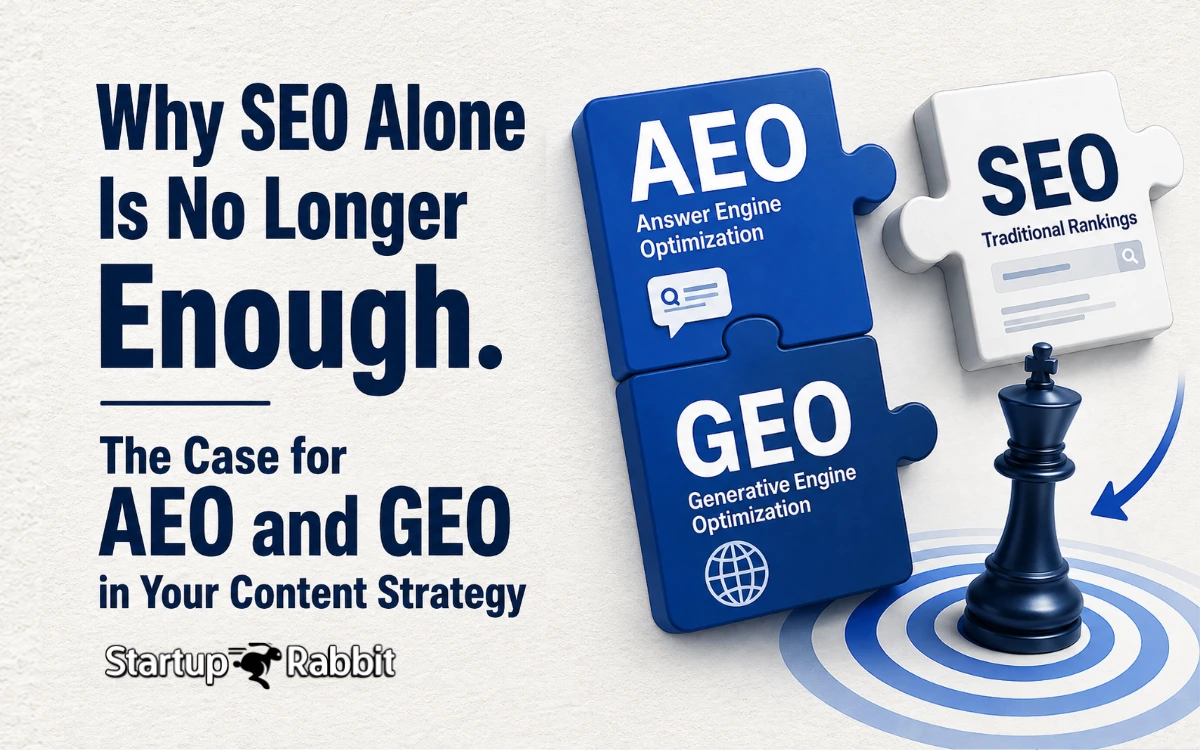
Search has evolved from blue links to a rich mix of answers, conversations, and AI-generated responses. The SEO of the past involved optimisers vying for page-one placement; that’s now just one piece of the pie. As answer engines, AI assistants and generative models alter information retrieval, modern practitioners need a wider range of tactics. Here we will explore why SEO vs AEO vs GEO matters, how search has changed. Also, the steps the teams must take to develop a combined content approach that will keep brands discoverable across search, answer, and generative models. We will focus on actionable insights for Indian content marketers and companies preparing for a competitive landscape by 2026.
Understanding SEO vs AEO vs GEO
What Is Search Engine Optimisation (SEO)?
SEO (Search Engine Optimization) involves tuning your website’s content, architecture, and authority to increase the ranking in search engine result pages and drive more free/organic traffic. At its essence, the practice of SEO helps search engines to understand and associate your content with user search terms.
What Is Answer Engine Optimisation (AEO)?
AEO means content optimization for quick retrieval searches for search engines and AIs like Siri and Alexa, not for page rank in web search. AEO means optimization for Featured snippets, Knowledge graphs and for voice search ranking for the user’s need of getting answers instantly.
AEO wants users to get their answer straight away, so this makes the AI much more accessible to index and crawl your content. It makes it more conceivable that your pages will feature in a direct answer and a voice search.
What Is Generative Engine Optimisation (GEO)?
GEO is the process of structuring your content in a way that AI search engines like ChatGPT and Google Gemini can understand and recall information from. AI search engine result pages are not websites. But they collect information to help directly answer a question. There is an increased chance that your content will be AI with GEO.
Why These Three Strategies Are Often Confused
SEO, AEO, and GEO are three integrated efforts for online discoverability. But they’re interacting with entirely different sets of algorithms and user intents. What can be confusing is that all three involve a search algorithm. However, their objectives and how each of the platforms serves varied data.
How Search Behaviour Has Changed in the AI Era
1. Key phrases are phased out in favor of actual conversation. Users will engage with longer, conversational search queries that will undoubtedly drive the use of natural language processing (NLP).
E.g., “What’s the greatest trick to tame frizzy curly hair in humid and tropical climates?”
2. Search on many platforms will take off as ChatGPT takes the reins in the AI search space. This will also lead more Gen Z to rely on TikTok as well as Instagram for authentic content.
3. Zero Click will take away from the way users engage online; it will NOT eradicate any form of organic traffic, but will significantly decrease the opportunity of any top ranking content reaching some organic click traffic.
Search Engine Optimisation vs Answer Engine Optimisation
Traditional Ranking Goals of SEO
An SEO user would land at a website either for in-depth information or an immediate answer, such as from a SERP feature. An AI search engine, conversely, would simply deliver the full answer at the top from AEO.
How AEO Focuses on Answer Visibility
AEO uses your content and links your source (when referenced and mentioned) within AI search answers (and voice search), to increase brand visibility and drive organic traffic.
User Intent Differences Between SEO and AEO
An SEO user lands on a site for additional context or an instant answer via a SERP feature. An AI search engine delivers in-depth context directly from AEO.
When Businesses Should Prioritise Each Strategy
While SEO helps rank higher and appears higher up on search and within AI generated answers, the benefit is to capture the organic traffic. Conversely, AEO’s goal is to be seen within the AI by means of citations and brand placement in an AI generated response.
Where GEO Fits Into Modern Search Marketing
“Zero-click” searches and AI Overviews are leading to a decline in site clicks. If your brand is stuck in the internet’s “link layer,” you’re now out of sight for millions of users. Instead, they’re discovering the world through AI assistants.
GEO is our modern marketing approach to grabbing your share of the “Response Layer” because AI engines don’t index and rank like Google’s old approach. They care about:
- Semantic Depth – Does this content really say something about the topic or is it filler?
- Trust Signals – Do other sources of authority mention your brand?
- Structure – Is information logically formatted for instant machine processing?
SEO vs AEO vs GEO – A Side-by-Side Comparison
| Feature | SEO (Search Engine Optimization) | AEO (Answer Engine Optimization) | GEO (Generative Engine Optimization) |
| Primary Goal | Rank higher on search engine result pages (SERPs) to earn clicks. | Provide direct, concise answers for featured snippets and voice assistants. | Ensure your brand/content is used and cited as a trusted source by AI models. |
| Target Engine | Traditional engines (Google, Bing, Yahoo). | Answer engines (Google Featured Snippets, Siri, Alexa). | LLMs & AI platforms (ChatGPT, Perplexity, Claude, Gemini). |
| Key Focus | Broad/transactional keywords, page authority, and backlinks. | Natural language, Q&A formats, and structured data/schema markup. | Information gain, entity authority, and deep topical expertise. |
| Success Metric | Organic traffic, rankings, and click-through rate (CTR). | Answer box placement, voice visibility, and zero-click engagement. | Share of voice, AI citation rate, and brand mention frequency. |
Why SEO Alone Is No Longer Enough
SEO on its own is insufficient due to the increased competition in search results. Enhanced visualization and zero-click direct answers result in page rank alone but do not provide traffic or leads.
Presently, users often find answers through snippets, AI summaries, and zero-click results. Therefore, few people visit the website even though the content may rank well.
Brands must also distribute content across various platforms such as social media, email, video, and LinkedIn, where buyers actually consume content.
So now, authority holds the same weight as keywords. Businesses need to foster trust by offering valuable information, insight, and a unified brand presence.
Ultimately, when you boil it down, SEO can be a piece in the larger marketing picture, but not the entire picture itself. As all three components are interrelated.
Google SGE Impact India – What Businesses Should Know
Understanding Google’s AI-Powered Search Experience
Google Search Generative Experience (SGE) is an AI feature that enhances the standard Google search results with conversational and contextual elements. Rather than sending users back to links, Google now shows natural language processing summaries, insights, and recommendations directly on the search results page.
How SGE Changes Search Result Layouts
The user can produce images by, for example, the prompt “Draw a futuristic house” or “See a lake in a calm evening.” Images produced by the system are shown as a slideshow, and clearly identified as AI-generated images. This integrates into Google Image search and is accessible through Google Search Labs.
Effects on Organic Traffic and Visibility
Thought leadership is a good strategy. It educates the audience with content that links to SGE answers without needing to click on the website. It gives the brand the presence and authority it seeks. Although traffic may not increase, the traffic will be more engaged and higher quality. Consider taking your written content and creating video summaries, audio snippets, or assorted interactive formats to make it more eye-catching. What’s more, with a Local SEO campaign, companies can show up in neighbourhood searches, which is bound to raise their presence in more compact markets.
Opportunities for Brands That Adapt Early
With an SGE landscape, having one of the top positions within the SERP doesn’t necessarily drive the most traffic. Rather, such an inclusion in machine-generated summaries is steadily becoming more valuable. This change requires SEO marketers to reconsider how to incorporate the new KPIs and metrics into their workflow, including previously unheard of “snapshot inclusion rate.” For AI to make improvements to visibility, marketers need to shift their emphasis to broader content planning strategies. They need to move beyond keywords to take context, entity relationships, and (user) intent into account.
AI Search Visibility India – How Brands Can Stay Discoverable
Building Authority Beyond Rankings
It is important for brands to highlight their credibility across several platforms as AI platforms look at brands with high authority and trust signals and expertise.
Optimising Content for AI Citations
Content that is well-structured, clear, and relevant is more likely to appear in AI-driven search results.
Creating Reliable and Verifiable Information
Use primary data to link to, use author bios, include methodology to increase trust signals for AI systems.
Establishing Strong Topical Expertise
Move beyond keyword ranking to becoming the dominant players in a topic’s niche. It means publishing clusters (bundles) of blogs, building comprehensive guides, employing the multiple usage of the same topics in different ways, along with positioning your brand as an industry authority. SEO and content strategies are integrated to create long-term strategies for boosting AI recognition.
Content Strategy SEO AEO GEO – Building a Unified Framework

How to Optimise for AI Answers in 2026
Optimise for AI answers in India: For questions in your content, provide a summary of 40 – 50 words that answers the question, as the first content in the post. Engage through conversational headings (rather than question headings).
Leverage schema markup and use bullets: Make your content read and understood by the AI by creating machine-readable content. Use an llms.txt file for AI crawlers, and make it accessible. As a result, you possibly can rely on little JavaScript.
Brand Trust (E-E-A-T): Authorship information and entity consistency might reflect your authority. Get external endorsements – through digital PR and citations.
Track Success: Expand upon traditional rank tracking and monitor interactions with AI. Brand prompting and measuring your AI citations with GA4 in reference to your referral traffic with UTM tags.
Search Intent Optimisation Across SEO, AEO, and GEO
Information Intent: The user is trying to learn or find an answer to a question (e.g. what is the future of search marketing in India). This will be met with long-form content, featured snippets or knowledge panels. Blog posts, faqs, tutorials and explainer videos are excellent here.
Navigational Intent: Google helps them get there like “Ahrefs login”. Unless your content specifically focuses on brand-based results. There are few opportunities here, and misunderstanding that these results is a good recipe for a bounce.
Commercial Intent: The intent to search for a specific type of product or services and to compare potential options before buying. “best keyword research tools”; is best practice for commercial intent content. This content is comparison articles, buying guides, product reviews, and case studies.
Transactional Intent: It means the intent to purchase, like “buy running shoes online”; to attract and convert this intent. Thereby, content types must focus on a specific product or service, the most common being product pages with very prominent calls to action (CTAs).
ChatGPT, Perplexity, and the Future of Search Discovery
| AI Search Platform | What It Rewards in 2026 | Google, ChatGPT, Perplexity, search SEO Tips |
| Google AI Overviews | Pages that demonstrate strong E-E-A-T (Experience, Expertise, Authoritativeness, Trustworthiness) and provide genuinely helpful, people-first content. | – Include first-hand experience with real implementations, client results, or tested methodologies. Build entity associations using structured data that connects your brand, authors, and topics to recognized knowledge graph entities. Support claims with primary source citations, such as research studies, official documentation, and regulatory guidance. Display author credentials through detailed author pages, verified expertise, social profiles, and publication history. Lastly, focus on helpful, user-first content instead of writing primarily for search engines. |
| Perplexity AI | Content that is factual, transparent, well-structured, and easy to cite. | – Start with a direct answer in the opening paragraph. Use question-based headings that match common user searches. Include specific statistics and data with clearly attributed sources. Publish consistently to build topical authority and domain trust. Last but not least, avoid thin content, excessive promotional language, and lengthy introductions before the main answer. |
| ChatGPT (Search-Enabled Modes) | Content that is easy for AI systems to extract, understand, and reuse. | – Write short, standalone paragraphs that make sense without surrounding context.- Use definition-first formatting, explaining key concepts in the opening sentence.- Add FAQ sections with concise, direct answers.- Implement structured data (Schema Markup), especially FAQ, HowTo, and Article schema to improve content organization and AI discoverability. |
Common Mistakes Businesses Make When Adopting AEO and GEO
Common Mistake 1: Overlook conversational and long tail search intent. Missing opportunities by not answering how natural conversations and long-tail searches work for AI-driven searches.
Fix: Include question-related headlines – plus use natural search language and phrases. Use the tools People Also Ask and AnswerThePublic for popular search terms and topics.
Common Mistake 2: Forgetting Schema Markup and Structured Data. How you structure data is going to hinder the search engines ability to understand your content.
Fix: Use schema markup for things such as FAQ, HowTo and other things applicable on all your pages. Validate it with Google’s Structured Data Testing Tool to check for mistakes.
Common Mistake 3: Keyword Stuffing and unnatural language. A website plagued with “keyword stuffing” works against the website and search engines want something with rich semantic data and not keyword density.
Fix: Repetition in terms of language and synonyms. View semantic data with tools.
Common Mistake 4: Ambiguous or fluffly answers. Providing vague answers is something AI will pass by in favor of concise and informative ones.
Fix: A direct answer to a question can be found in 1-2 sentences at the beginning of the content; afterward provide more detail if need be.
Common Mistake 5: Mobile Optimization and Voice Search. Not having mobile optimization or optimizing for voice search could decrease the chances of it appearing in a search summary.
Fix: Write in a natural way, the page loading speed is important, test to see what answers can be read from the screen by a voice assistant.
AEO GEO SEO Strategy 2025 and Beyond
SEO is about old-fashioned discoverability, and optimizing to get a good ranking on Google search engine result pages. Linking content to user intent is key, as is fast page speed and secure HTTPS, as well as acquiring quality backlinks to build authority.
2. AEO focuses on delivering short information on the zero-click searches and voice queries. Here are some actionable tips: have FAQ blocks, formatting, and schema markup.
3. GEO wants to establish its brand trustworthiness on various AI platforms. This also includes keeping brand consistency from your website across digital platforms. Also create in-depth content and conducting digital PR to improve brand visibility in AI training sets.
4. Tracking Performance uses two strategies:
- Google’s Search Console for SEO (Google’s data)
- AI such as ChatGPT for brand mentions, in AEO and GEO.
Future of Search Marketing India
1. The Rise of “Zero-Click” Interactions
Search engines are shifting from sending people to sites to directly answering their queries on the results page. As it’s predicted, website traffic may decrease with informational queries-since people can get answers like “list of CRMs for startups in Bangalore” directly from the SERP. Businesses will need to make sure they appear on these answers instead of just getting clicks.
2. Multimodal Search Becomes Standard
Voice, video, and visuals will be part of search by 2030. Users will be able to perform a search by simply looking through their cameras, or via spoken voice commands. Content with clear visuals (images, video) will be important.
3. Hyper-Personalization
Search results will be fully personalized; your search will factor in budget, taste, and location. It is in other words two persons searching for ‘generative engine optimisation India’ will have two different outcomes.
4. Predictive Search
Search results may become predictive, providing options by accessing a user’s calendar and purchase history. Search will go from being a reaction, to something more proactive.
Practical Framework for Combining SEO, AEO, and GEO
- Consider existing content for SEO effectiveness and AEO readiness (frequently asked questions) and GEO suitability (depth and authority).
- Know what keywords to use for SEO, questions to ask for AEO and subjects for GEO that are often referred to on AI platforms.
- Write keyword-rich, answers or answers for specific questions, relevant keywords, and content with in-depth information (AEO, SEO, GEO).
- Implement structured data, enhance site speed, and mobile-friendly and mobile responsive to meet both the SEO and AEO needs.
- Monitor performance with each of the three optimization areas and take necessary adjustments.
- Gain authority, reputation and trust via back-links (SEO), customers and followers (AEO) and in-depth, trusted information (GEO).
- Use multiple access points such as traditional websites, voice assistants, and AI platforms to spread your content out as far as possible.
Conclusion
SEO vs AEO vs GEO can no longer be separate strategies; they are increasingly complementary in securing visibility for a brand within the emerging AI ecosystem. SEO continues to drive traffic and conversions, AEO claims the top position to steal eyeballs, while GEO lands customers into the AI’s direct answer. As brands in India and beyond build their online strategy, a multi-layer optimization strategy will be key. From short, citable answers that power AEO, authoritative pillar content for SEO, and well-sourced, structured content for GEO, brands must cater to user intent, utilize schema markup, and measure AI citations to achieve success.
FAQs
SEO means being the answer, not ranking on the standard search result page. AEO means being the direct, instant answer. GEO ensures you’ll be the reference that an AI mentions.
No, GEO (Generative Engine Optimization) is not a replacement for SEO.
AEO is becoming important because of the rise of generative responses and voice-based search.
Google SGE, now called AI Overviews changes the nature of SEO because it creates AI based answers at the top of a search results page.
As we are shifting to an AI powered search engine, businesses have to reevaluate and redefine their SEO strategy and moving from a Click SEO approach to GEO search.
To lead in AEO, a company should concentrate on writing conversation-oriented and well-structured content. This content immediately responds to the user query and also becomes a citation in AIs such as ChatGPT and Perplexity.
When you feed any query to ChatGPT to retrieve data from the internet, it uses an artificial intelligence technique named Retrieval Augmented Generation (RAG).
The future of SEO moves away from the traditional keyword ranking chase and into being AI aware and cited in a synthesized result.

Related items
Advertising today spans far more than a single print ad or a billboard — it’s a coordinate
Navi Mumbai has changed a lot in the last few years – healthcare, real estate, manufacturi
Almost every business owner eventually asks the same question: should our ad budget go to