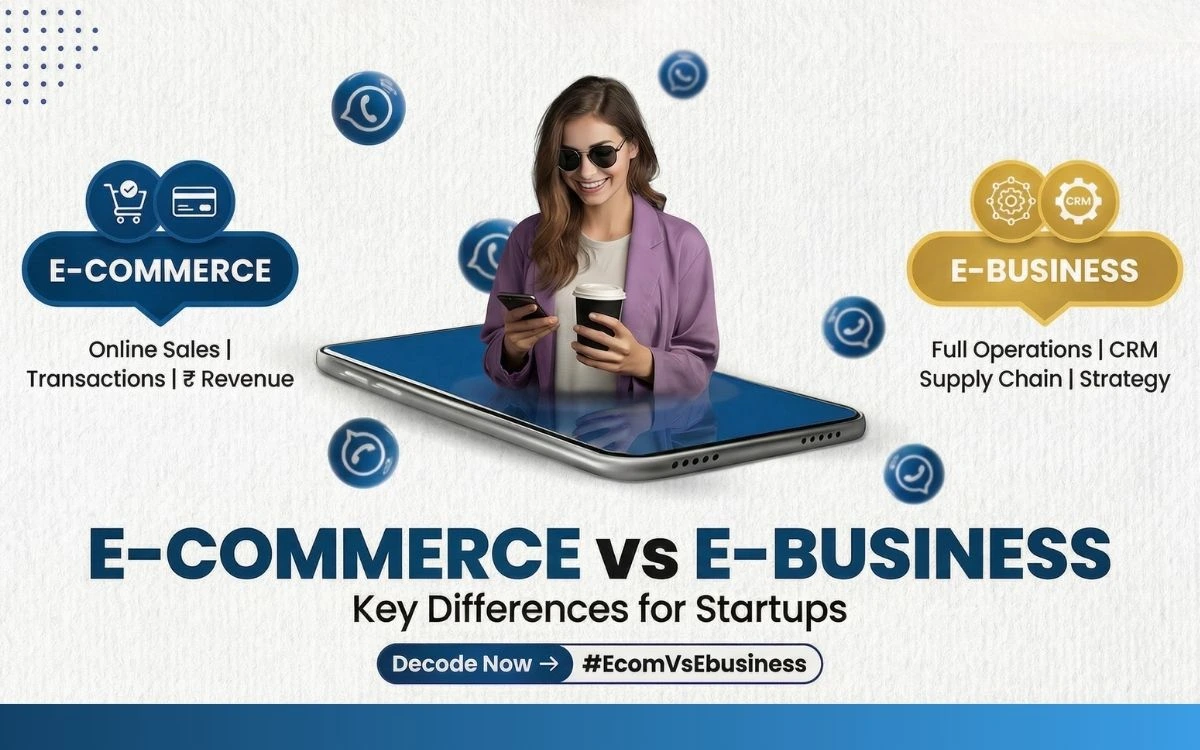
Difference Between E-commerce and E-business for Startups
One of the first questions asked when a startup is launched is: Should we create an online store or a full-scale digital business? It is in this context that the difference between e business and e-commerce comes in handy. E-commerce refers to the sale of goods or services online, whereas e-business refers to the broader digital infrastructure that supports such transactions, as well as other activities.
When you consider what you can sell online, you may miss the overall picture of how the digital tools can be used to simplify operations, customer support, and partnerships. Therefore, it is better to understand the difference between e commerce and e business as early as possible. It will help the startup to select the right model, the right tools, and save money on the features they are not yet in need of. So now, let us begin.
What is e‑commerce?
E‑commerce meaning in simple terms
Electronic commerce, or e-commerce, is the process of buying and selling goods over the internet. In such a transaction, the seller can generate a smooth transaction process without the need to meet the customer. Not every e-commerce site is the same; there are various types, some simpler than others.
Core activities involved in e‑commerce
The core activities of e‑commerce typically include:
- Purchasing and selling the item on the web.
- Online ticketing
- Online Payment
- Paying different taxes
- Online accounting software
- Online customer support
Scope of e commerce in modern businesses
Today’s e‑commerce goes beyond simple online stores. It includes:
- Business-to-Business (B2B) – This is an online e-commerce model in which businesses sell goods or services to other businesses/other businesses. One such example is a digital marketing firm that offers marketing services to other businesses.
- Business to Consumer (B2C) – The business-to-consumer model is somewhat different because it deals in businesses selling their wares or services to the consumers. It is, in fact, the most prevalent form of e-commerce since it is the most prevalent in the interconnected world. Online shopping is more popular than in retail stores, and the COVID-19 pandemic’s lockdowns have helped spread this model due to its ease, time-saving, and convenience.
- Consumer to Consumers (C2C) – This model is that of consumer-to-consumer, where all the digital e-commerce is done among consumers. This is typical on the internet, often seen on Etsy, eBay, Facebook Marketplace, and similar marketplaces.
- Consumer-to-Business (C2B) – In this approach, individuals offer their goods for sale to a business. Digital influencers who offer their services to their fans are a good example of this. At the moment, it’s very popular because the rise of the influencer has changed the way marketing works and is still changing how people decide what to buy.
What is e‑business?
E business meaning
E-Business can be defined as the conduct of all forms of business using the internet. It entails activities such as purchasing raw materials/goods, educating customers, buying and selling of products for manufacturing, and conducting monetary transactions, all over the internet. E-business uses the internet, intranets, and extranets. E-business needs websites, apps, ERP, CRM, etc.
Core activities involved in e‑business
- Online store setup
- Customer education
- Buying and selling a product
- Financial transaction of business.
- Supply Chain Management
- Email marketing
Difference between e‑commerce and e‑business (core comparison)
Difference between e‑business and e‑commerce in definition
- E‑commerce: E-commerce is restricted only to online purchase or sale to a client or a supplier.
- E‑business: E-business is a wider term that embraces all business operations that are done using the internet, intranet or extranet.
Difference based on scope and functionality
- E‑commerce: E-commerce is only concerned with online transactions of purchasing and selling goods and services via websites or applications
- E‑business: The scope of e business encompasses a broader range of activities, including supply chain management, customer service, marketing, and data analytics. It enhances business processes and decision-making with the help of digital tools.
Difference based on customer interaction
- E‑commerce: E-commerce is customer-oriented, focusing on attracting customers, providing a seamless shopping experience, and ensuring prompt delivery, all of which prioritize customer satisfaction.
- E‑business: E-business manages internal and external processes, like supplier relationships and operational efficiency, using technology for better performance and growth.
Difference based on technology and infrastructure
- E‑commerce: E-commerce involves the use of websites, payment gateways, and shopping carts. These involved activities are used to browse, pay, and track the orders, keeping the transactions safe.
- E‑business: E-business uses modern technologies such as CRM, ERP, AI, cloud computing, and social media to promote customer communication, automate business processes, and efficiently handle data.
Difference based on business objectives
- E‑commerce: E-commerce targets sales revenue.
- E‑business: E-business is geared towards efficiency, automation, and operational improvement.
Difference between e commerce and e business – tabular comparison
| Particulars | E-commerce | E-business |
| Meaning | It refers to performing online commercial transactions and activities over the internet. | It refers to performing every type of business activity through the internet. |
| Scope | It is a narrow concept and is a subset of e-business. | It is a broad concept and is a superset of e-commerce. |
| Transactions | Commercial transactions are carried out in e-commerce. | Business transactions are carried out in e-business. |
| Limitation | E-commerce transactions are limited. | E-business transactions are not limited. |
| Activities | It includes selling and buying products, making monetary transactions, etc., over the internet. | It includes customer education, procurement of raw materials, supply activities, making monetary transactions, etc., over the internet. |
| Operation | It mainly requires the use of only a website. | It requires using multiple websites, ERPs and CRMs, that connect different business processes. |
| Resources | It involves mandatory use of the internet. | It consists of the use of the internet, extranet or intranet. |
| Business models | E-commerce is appropriate in a Business to Customer (B2C) context. | E-business is appropriate in a Business to Business (B2B) context. |
| Coverage | E-commerce covers external/outward business processes. | E-business covers internal and external business processes/activities. |
Types of e‑commerce business models
In terms of types of e business models, there is no difference between e commerce and e business. E-business implements the same e commerce business models, which are mentioned below:
- B2C (Business-to-Consumer): This is selling to individual consumers (e.g., fashion and beauty or electronics).
- B2B (Business-to-Business): The sale to other businesses (e.g., raw materials, SaaS platforms).
- C2C (Consumer to Consumer): Community websites, in which people can sell to one another (e.g., OLX, Facebook Marketplace).
- D2C (Direct-to-Consumer): Brands market directly through their channels, eliminating middlemen.
Features of e‑commerce vs features of e‑business
Typical features of e commerce:
- Online transactions: All the buying and selling is conducted online.
- Transactions via the internet: Debit/credit cards, wallets, net banking, or UPI can be used for cashless payments.
- Digital Storefronts: Businesses are those that sell and market products online via websites or apps.
- Customer Contact: E-commerce mainly sells to the customers without involving internal business processes.
Typical features of e business:
- All Business Processes: It includes all the business processes, such as online marketing, customer relationship management (CRM), and digital operations.
- Not Only Sales: E-business is not about sales alone, although e-commerce sales are its primary concern. It entails inventory control, customer care, and supply chain operations.
- Employs Digital Technologies: Companies make use of emails, websites, social networking, cloud computing, and data analytics.
- Internal and external communication: E-business entails online employee training, telecommuting, and automated operations.
Advantages and disadvantages of e‑commerce
What are the advantages and disadvantages of e commerce for startups?
- Grows Sales and Revenue: E-commerce increases market penetration, bringing in new customers and enabling discounts and incentives unavailable in brick-and-mortar outlets, as well as cross-selling and up-selling.
- Saves Money: No physical stores or sales personnel are required, minimizing inventory and delivery expenses and creating cost-saving opportunities through online auctions and efficient supply chains.
- Removes Geographic Borders: Customers can shop anywhere in the world, and the business can access new markets and increase its customer base, which may decrease the operational expenses.
- Enhances Customer Services: Provides 24/7 customer service, price and product comparison, and other services such as customer reviews and ratings, which make the shopping experience much better than the physical stores.
- Enhances Efficiency: E-commerce systems are used to improve order processing, eliminating paperwork and human error and providing real-time inventory levels and sales trends.
Disadvantages and limitations of e‑commerce
- Absence of Social Interaction: Online shopping deprives the customer of socialization since they do not see or touch the products, and this may end up frustrating them if the expectations are not met.
- Security Risks: Online transactions are dangerous due to the risk of theft of sensitive financial information. It results in financial losses and identity theft.
- Challenges in ROIs: Online purchases may be difficult to return. This is because most companies require the product to be returned in its original packaging, and the shipping costs are likely to be included.
- Absence of Trust: Online shopping can make consumers distrust it because of the fear of being cheated or of not receiving the ordered products, which can affect compliance with the purchase.
Advantages and disadvantages of e‑business
Benefits of e‑business for scaling companies
- Global Access: The ability to reach a large customer base and even foreign markets, expanding geographical horizons, is facilitated.
- Cost Effectiveness: E-business does not require any physical infrastructure; therefore, there is no need to incur operational expenses such as rent and utilities.
- 24/7 Availability: The web platform helps the businesses to be online and never go to sleep to provide their customers with offerings of products and services around the clock.
- Improved customer experience: E-commerce uses chatbots, personalized recommendations, and fast delivery to enhance customer satisfaction.
- Enhanced understanding of data: These platforms help companies track customer preferences, purchases, and trends to inform decision-making.
Challenges in implementing e‑business systems
- Cybersecurity Risks: Hacking, Data breaches, and phishing attacks are weaknesses of online businesses.
- Dependence on Technology: It will disrupt business operations due to technical issues such as software malfunctions or website failures.
- Extremely Competitive: Online businesses are characterized by intense competition due to the ease of entry into the e-business environment.
- Reduced Face-to-Face Contacts: Customers will lose the personal touch of face-to-face contact.
- Logistics Challenges: The shipping, delivery, and handling of a returned item are always problematic for any e-business and cost a lot of money.
E‑commerce and e‑business: how they work together
In practice, E-commerce and e-business collaborate. The latter makes the former a customer-facing front-end. and handles the digital business operations front-end like:
- Supply chain
- CRM
- HR systems
E-commerce is a branch of the e-business strategy.
Which is better for startups – e‑commerce or e‑business?
In the case of startups, the e-commerce is more appropriate for rapid, low-cost penetration of the market with direct sales orientation. In contrast, e-business is more scalable in the long term and more efficient in operations. E-commerce is limited to the process of buying/selling online, but e-business is more extensive as it involves the internal processes (CRM, ERP).
Common misconceptions about e‑commerce and e‑business
Misconception 1: E-commerce is only for large businesses.
Reality: E-commerce is available to both large and small businesses. Affordable online page creators like Shopify and Wix enable small businesses to build a powerful online presence without a massive budget.
Misconception 2: An e-commerce website is expensive and difficult to build.
Reality: It is untrue that developing a website with the right e-commerce development firm can be both achievable and affordable. Several agencies like Startup Rabbit can sell tailored solutions that fit different budgets, and therefore, the process can be managed.
Misconception 3: E-commerce Websites do not need SEO.
Reality: SEO plays a vital role in generating traffic to e-commerce sites. People have the misconception that just opening a site will increase traffic. But without effective SEO, the site will not be found. Hiring an e-commerce search engine optimization service would increase the visibility and organic traffic.
Misconception 4: E-commerce Marketing is Highly Expensive.
Reality: Although marketing demands investment, it can be done even within various budgets. The local market can be used to develop cost-effective e-commerce marketing strategies, e.g., pay-per-click and social media advertising, which enable the maximization of return on investment.
Conclusion: Final verdict for startups and entrepreneurs
For startups, the difference between e commerce and e business is not a mere rational choice, but a strategic one. E-commerce allows you to experiment with demand, create revenue, and create a brand within a short amount of time. E-business allows you to scale more effectively, spend less, and improve the customer experience.
The smart approach is to begin with a singular e-commerce framework and add on the e-business aspects, including CRM, automation, and analytics. In that manner, understanding the difference between the two will help you avoid overspending and build your online infrastructure at an early age.
FAQs on Difference Between E commerce and E business
E-commerce entails the online purchase/sell of goods/services only. In comparison, e-business is a more generic term for all online business processes.
It is possible, of course, to have a business that is an e-business without carrying out e-commerce.
Amazon is an online retailer, a global leader in online commerce, and a large-scale e-business, but it is also a multi-dimensional e-business.
High-margin, quickly scalable startups are typically AI-first SaaS (Software as a Service) companies.
E-business can be subdivided into an element of e-commerce.

Is YouTube a Social Media or a Video Platform? What Google Says
There is always debate over whether YouTube qualifies as a social media platform or is a video giant in its own right. The question “Is YouTube social media?” generates complexity since, in some places, the platform combines the concepts of video search and social interaction in unexpected ways. We can simplify it step by step to understand why it is important to creators, businesses, and ordinary users.
What Is Social Media?
Social media is any online service or site where people can interactively share information, content, and interests with others. The popular social media platforms are:
- X (Twitter)
Is YouTube Considered Social Media?
The question of whether YouTube is social media continues to perplex many people. This is because YouTube does not resemble other platforms.
It’s full of videos. It would even be similar to watching TV. But it does not end here. YouTube is a connection-based platform. Now, let us see how YouTube is social:
- By subscribing to their channels, you can follow your favorite creators.
- You are also free to participate in the discussion by posting comments and responding to others.
- You can belong to a group that shares your interests.
- You can post your own videos and share your ideas with the world.
- These are the core features of social media. It is not only about watching but also about talking, sharing, and connecting.
Social Features That Make YouTube a Social Media Platform
- Content Sharing: The users are able to share videos with the world. They can be repeated and viewed by any person with internet access. This renders the platform quite social and open.
- Liking and Reacting: The viewers are able to like and dislike videos. This shows what people think. Likes serve to expose good content to more people.
- Commenting: Under the videos, people have the chance to comment. They exchange ideas, pose questions and provide feedback. This brings about dialogues between audiences and artists.
- Subscribing and Following: Subscribers are allowed to follow the creators of their choice. This will keep them up to date on new videos. It is also useful in creating a base of faithful fans among creators.
- Live Interaction: YouTube supports live streaming. In live videos, the viewer can chat in real time. This renders the experience more intimate and interpersonal.
- User-Generated Content: Anyone can make and post videos. It’s not just big companies. Regular people can create videos and attract millions of followers. This constitutes one of the important components of social media. YouTube creators who have millions of followers do exist. Their content is controversial, trending, and viral. Like any other platform, fans congregate in comment sections and livestreams.
How YouTube Functions as a Video-First Platform
Primary video-first functions:
- Focus on Video: YouTube was designed to support video, unlike other platforms that had to adapt to it. It encourages high-quality long-form video, live streaming, and Shorts that satisfy the demands of a broad audience for in-depth content.
- Discover and locate a great deal: YouTube is the second-largest search engine globally. Its algorithms are aimed at matching people with content they are likely to find entertaining based on their search history, not just their social connections.
- Creator-Centric Ecosystem: YouTube provides plenty of ways to make money (Partner Program) and control content (material ID) to motivate people to produce original, high-quality content.
- Community Interaction: The site allows community members to interact through comments, video responses, live discussions, and community postings based on shared interests.
- Adaptive Technology: YouTube lets users from all over the world use the site because it offers different streaming rates that change based on the user’s Internet speed. This makes the videos play without any inconvenience.
What Google Says About YouTube
YouTube’s Position Within the Google Ecosystem
Google leads in the digital world, not just with YouTube. Its success comes from a wider strategy using various platforms and technologies. Google’s services like search, ads, and cloud create a strong ecosystem that boosts YouTube’s power as a visual platform.
Is YouTube Treated as Social Media in Google Search?
In fact, YouTube is seen as a social media site in Google Search and digital marketing. This is mostly because YouTube is a place where people can make videos, comment on them, and build communities. Still, it is ranked as a special search video engine, and Google often shows it as a result of a search query.
YouTube’s Role in Search, Video SEO, and Discoverability
The key to the Google strategy is the smoothness of the integration between YouTube and the search engine. The integration guarantees the visibility of video content in search results, thereby increasing discoverability. By utilizing the search algorithms of Google, YouTube can rank its content suggestions. This means that the users will find it much easier to find the videos relevant to their interests. This is a strategic synergy between the search and video content that increases the reach and impact of YouTube.
Brief History of YouTube
When did YouTube come out?
YouTube was introduced in 2005 and became one of the most popular video-sharing platforms on the Internet, where people can post their own content and interact with others. By 2019, more than 517 hours of content were uploaded per minute, and by 2023, a list of approximately 14 billion videos was in place.
Who owns YouTube now?
Google now owns YouTube. After the acquisition in 2006, YouTube saw an increase in the user base. Users had to log in with a Gmail account.
Since then, it has grown to include long-form videos, premium content with subscription choices, TV packages, and a creators’ studio. This has given content creators ways to make money and made the experience better for everyone.
Is YouTube Social Media for Marketing Purposes?
The reasons why you should use YouTube to market:
- Long-Term Value (Evergreen Content): Videos continue to be viewed and generate revenue, making them a good long-term investment compared the platforms like Instagram or TikTok, which users soon forget.
- User Intensive: Users usually visit YouTube to learn more about products, improve their skills, or resolve issues. This renders the prospective buyers more specific and encouraged.
- Strong Ads and statistics: YouTube Ads, a subdivision of Google Ads, allow reaching specific audiences with the help of such data as demographics, interests, and search history.
- Community Engagement: Live streams, comments, communal votes, and channel subscriptions can help the businesses learn more about their audience and gain their trust.
- SEO Advantages: Google owns YouTube, so movies on the site are usually ranked highly by the search engine, making them available by default.
YouTube vs Social Media vs Streaming Platforms
| Feature | YouTube | Social Media (IG/TikTok) | Streaming (Netflix/Prime) |
| Content Type | Diverse, User-Generated, Long-form & Short | Short-form, Image-based, Fast | Professional, Premium, Long-form |
| Longevity | High (searchable) | Low (ephemeral) | High (library-based) |
| Monetization | High (Ads, Ads, Memberships) | Medium (Creator Fund, Brand Deals) | Subscription-based |
| Best For | Searchable tutorials, vlogs, long video | Trends, quick updates, social networking | Binge-watching, premium entertainment |
| Algorithm | Search and Recommendation | Feed-based Discovery | Recommendation-based |
Is YouTube Social Media for Businesses and Creators?
YouTube Social Media for Businesses
- YouTube is an effective business promoter. To build trust, companies create tutorials, demos, explainer videos, and reviews.
- Interesting content resolves the queries of viewers and attracts likes, comments, and shares.
- Companies can conduct targeting of the paid advertisements based on demographics and interests.
- Views, clicks, and conversions can be easily tracked.
- YouTube improves visibility of the brand, customer interaction, and lead generation. It is a social media interaction type based on video.
YouTube Social Media for Creators
- YouTube creators are the main participants of YouTube. They are the personalities or groups of people who produce videos on various issues. Some focus on gaming like Angidad Gaming. Others post beauty tips, technology reviews, or vlogs of the day.
- They do not just post videos. They build communities. These creators engage audiences by commenting, liking, and going live. This process forms a relationship between the fan and the artist.
- Several creators have dedicated followings that regularly patronize them. Customers return to see all the new videos. It is an evident indication of social interaction. It is just like influencers operate on other sites, such as Instagram or TikTok.
- Some creators make money. They monetize their content through ads, sponsorships, or memberships. This makes YouTube into a social and professional arena. Therefore, is YouTube a social media platform for creators? Without a doubt, yes. It provides them with a platform and helps them develop.
- Now we will see how schools and teens use YouTube as a social media platform.
Advantages of YouTube as a Social Media Platform
1. Broad Reach and Engagement
YouTube has a massive reach, with billions of active users. Such a large network has the potential to make brands and creators very active.
2. SEO and Visibility
YouTube content ranks highly in search results because it is the second-largest search engine after Google. The visibility can be enhanced through the addition of search engine-friendly keywords like YouTube, social media, video marketing, and content creation.
3. Various formats of content
The several categories of content on YouTube, i.e., tutorials, vlogs, product reviews, and live events, allow people to narrate various stories. This allows a large variety of content approaches and appeals to a large audience.
4. Data-Driven Insights
YouTube analytics is very specific; the user can gauge engagement, demographics, and performance of the content. Such information cannot be overvalued in the strategy optimization and meeting social media objectives.
Limitations of YouTube as Social Media
1. The Saturation of content
Millions of videos are uploaded each day, and you need something different and specific marketing strategies to be noticed. Niche themes and creative narratives can be used to overcome this problem.
2. Reliance on Algorithms
The YouTube suggestion algorithm can suggest a video. Staying abreast of the changes to algorithms and utilizing data can assist you in getting your content to more people.
3. Marketing and Policy changes
The creators are forced to contend with ongoing changes in copyright and marketing regulations. Such changes and the need to adapt to them are significant strategies to maintain.
4. Engagement Consistency
Be consistent with your content. Add new posts, engage with viewers through comments, create community posts, and collaborate to build an active community.
Common Misconceptions About YouTube and Social Media
Myth 1: YouTube does not encourage the use of videos containing warnings.
Reality: YouTube algorithms operate autonomously across several functions, including promotion and copyright issues. The loss of monetization for a video does not mean it is disguised; it just means it cannot show advertisements. Suggestions may be made regarding the material in accordance with community rules, and copyright claims do not always prevent visibility.
Myth 2: You can not edit the thumbnail or title of a video that has been published.
Reality: The thumbnail or title can be changed to encourage positive engagement if viewers respond positively. YouTube is more focused on the interaction with the audience compared to the inanimate elements, which implies that a successful change may increase the visibility.
Myth 3: Your channel will wither up when you stop posting content.
Reality: A break does not always damage a channel. Looking at examples from YouTube shows that when artists aren’t around, it doesn’t hurt promotion as long as they find other ways to keep viewers entertained.
Myth 4: A bad video will destroy the whole channel.
Reality: The failure of one video does not characterize the success of a channel. Consistently poor performance can be cause for concern, yet failure, in some cases, is common among creators and will not result in immediate ramifications.
Myth 5: Timestamps negatively affect watch time.
Reality: Timestamps can improve the viewer experience because they are easily navigable. They can increase retention and advertise videos, particularly when they are used effectively to emphasize interesting content.
Myth 6 Tags facilitate promotion.
Reality: Tags are not as important as metadata, such as titles and descriptions. They play a minor role in search and cannot be used effectively for promotion.
Myth 7: Shorts harm channels.
Reality: Shorts have the potential to co-exist with long-form content, which may redirect to longer videos. Their effectiveness, however, depends on the channel type, and it is advisable to strategize on how to use them.
Conclusion
YouTube is not merely a video platform; it has profound social media qualities because Google places YouTube in the search and sharing structure. The question “Is YouTube social media?” highlights how the platform is multifaceted, with creators and companies using it to sustain themselves and gain interaction. Accept it as the two to maximize your B2B strategies.
FAQs About Is YouTube Social Media
Yes, YouTube is a social media platform that is popular among the marketers.
YouTube can be described as belonging to the hybrid category; it is a significant search engine and a social network at the same time.
Yes, YouTube is capable and does take the place of other social media platforms, as a hybrid platform. It combines content consumption with social networking, community building, and search engine features.
Yes, YouTube is a hybrid because it is both the best social media channel and the second-largest search engine in the world (owned by Google). Thus, it cannot be ignored in branding and SEO.
YouTube’s headquarters are located in San Bruno, California, United States.

What Is a Nano Influencer? Complete Guide to Micro-Reach, Macro-Impact
Modern brands pursue an authentic relationship rather than a large reach. Nano influencers with their small yet devoted audiences can provide just that. Their engagement levels are as high as 50 times greater than the other creators, making ordinary posts effective recommendations.
In 2026, 44% of businesses prefer nano influencer for their authenticity and ROI. Unlike mega stars with polished feeds, nano influencers spark real conversations that drive trust and sales. This trend is more in favor of cost-effective strategies, particularly when it comes to the small businesses and niches. Nano influencer marketing demonstrates that small voices can produce big effects, transforming campaigns in the globe.
What Is a Nano Influencer?
Simple Definition of a Nano Influencer
One such small but effective influencing capability on social media sites falls under the nano influencer category. The great strength of nano-influencers is the authenticity and genuine connection to their audience. They also enjoy adding value by providing relatable, more personal information for their users. It could be photos of their family, movies of hilarious cats, or memes. It makes people feel more connected and trustworthy than macro-influencers.
Typical Follower Range and Platform Presence
The number of followers of the nano influencer can range from 1,000 to 10,000; however, some sources limit it to 1K-5K. They benefit greatly from Instagram, TikTok, and YouTube, as these platforms have seamless one-on-one communication.
How Nano Influencers Differ from Regular Social Media Influencers
| Aspect | Nano Influencers Advantage | Regular Influencers |
| Follower Count & Niche | Narrow, focused communities | Wider but less targeted reach |
| Engagement Rates | Highest; personal replies to comments/DMs | Lower due to scale |
| Authenticity & Trust | Peers/friends; highly relatable, higher conversions | Less personal trust |
| Cost-Effectiveness | Cheap (gifting or low per-post fees) | High payments demanded |
| Content Style | Informal, unfiltered, like endorsements | More polished, ad-like |
Types of Influencers Based on Follower Count
Startup Rabbit a social media agency in Navi Mumbai has ranked levels of influencers based on follower count below:
- Nano-Influencers: 1,000 – 10,000 followers
- Micro-Influencers: 10,000 – 100,000 followers
- Mid-Tier Influencers: 50,000 – 500,000 followers
- Macro-Influencers: 100,000 – 1,000,000 followers
- Mega-Influencers/Celebrities: Over 1,000,000 followers
Why Nano Influencer Marketing Works So Well
1. Higher Engagement Rates Than Larger Influencers
Nano influencers also tend to have more engagement rates as opposed to larger audience influencers. Their followers are more than interested in their content, so they receive more likes, comments, shares, and conversions. Research indicates that nano influencers can achieve up to an 8% engagement rate.
2. Strong Community Trust and Relatability
The nano-influencers normally enjoy one-on-one association with a section of the audience. Their suggestions are sincere advice rather than sponsored advertising. They have close relationships with their followers and they frequently have substantial conversations.
3. Cost-Effective Campaign Execution
In the case of brands, collaboration with nano influencers is less expensive compared to cooperating with celebrities. This has the benefit of opening the influencer campaigns to small businesses and startups without huge marketing budgets.
4. Authentic Conversations Over Paid Promotions
Nano influencers are known to target specific niches, making it easier for a brand to reach its target market. Whether organic skincare, eco-friendly fashion, or tech devices, collaborating with a nano influencer in the specified sphere will ensure the message reaches the right audience.
Nano Influencers vs Micro Influencers
| Aspect | Nano-Influencers | Micro-Influencers |
| Follower Count | Typically 1K-10K followers, offering hyper-targeted audiences. | Generally, 10K-100K followers, provide a broader reach while maintaining personal connections. |
| Engagement | Often enjoy exceptionally high engagement rates due to their intimate relationships with audiences. | While engagement percentages might be slightly lower, they reach more followers overall. |
| Content Style | Raw, personal, and niche-focused, which helps in building strong trust. | More polished content that still maintains authenticity but can scale to a wider audience. |
| Cost | More cost-effective, ideal for brands on a tighter budget. | Slightly more expensive but often offer a scalable solution for broader campaigns. |
| Audience Type | Target very specific demographics, making them perfect for niche marketing. | Strike a balance between niche and broad appeal, often delivering a mix of personalized and professional content. |
Platforms Where Nano Influencers Perform Best
1. Archive
Perfect when you want to automatically monitor all community content and illustrate the creator’s ROI without any human intervention. It takes user-created content from Instagram, TikTok, and YouTube, including ephemeral content. Key features include:
- Social listening
- Creator search
- Campaign reporting
- Brand safety vetting
- Smart AI fields
Archive is different from its competitors because it gives 400% more content than those competitors do. Because of this, it works well for managing gifting programs and ambassador campaigns. Some of the most important results are that different brands have saved time and made a lot more money.
Pricing: This is custom based subscription.
2. Stack Influence
Curated micro and nano influence platform of more than 11 million influencers in different niches. It is most appropriate for brands that want their campaigns run in a hands-off manner with a pay-per-post framework, where the brands pay when the influencers post. Key features include:
- Product-only compensation
- Campaign management End-to-end
- Influencer targeting by AI
Pricing: It is campaign-based and customary.
3. Upfluence
Proposes the service of more than 12 million influencer profiles and targets enterprise brands that require the use of complex discovery and e-commerce integration. Key features include:
- A highly developed search engine that has AI filters
- identification of influencers with existing customers
- Shopify integration
- An influencer analysis Chrome extension
Pricing: Customized pricing is offered, as well as free tools.
4. GRIN
It is the first Creator Management Platform in the world and represents major brands such as Uber and SKIMS. D2C brands with more than 100 creators with the need to automate workflow are best.
Key features include:
- End-to-end influencer CRM
- Most of these tools are influencer lookalike tools
- Product seeding
- Workflows related to automated payment
Pricing: It offers a free trial and 1799/month for full access.
5. Aspire
It focuses on the creation of long-term communities of creators instead of one-off campaigns, such as Samsung and Walmart brands. It is optimal for brands developing ambassador programs. Key features include:
- A creator marketplace
- UGC collection
- Affiliate tracking
- Hands-off execution managed services
Pricing: The platform has an ROI of 5.78 per dollar invested, and pricing can be commissioned.
Use Cases of Nano Influencer Marketing
Product Launches and Early Reviews
Putting new products in the hands of creators to have an authentic review to build trust, usually without payment but rather with free products.
Local Brand and Hyperlocal Campaigns
Hiring local artists to promote the visibility of physical places (e.g., local cafes, salons) in a particular city or neighbourhood.
User-Generated Content Creation
With the help of nano-influencers, one can produce natural, non-polished (photos, stories) content that the brand can repurpose on its channels.
Niche Market Penetration
According to Indeed and odience.io, this involves targeting very small groups of people (e.g., in skincare, niche gaming, or local eco-conscious communities) who regard the creator as trustworthy.
Direct Conversion to Sales (High ROI)
This is done by using personalized referral codes to drive sales, since nano-influencers achieve engagement rates of up to 8.7%, whereas celebrities achieve 1.73%, according to Archive.
Brand Loyalty Campaigns
Developing long-term relationships with loyal customers so they can become brand advocates.
Community-Led Brand Awareness
The most affordable (costing only $10 to $100 per post), which is why they are the best option for a small business looking to increase its exposure with limited resources.
Types of Influencer Marketing Campaigns Using Nano Influencers
- Sponsored Posts: Paid social media posts on social media platforms, where influencers make posts about the products of a brand. The influencers have to disclose paid partnerships with such hashtags as ad or labels paid promotion.
- Contests and Giveaways: This can improve social media use and involve influencers giving away brand products. By commenting or sharing posts, followers enter.
- Account Takeovers: The influencers post on a brand temporarily, increasing the reach and the engagement. Advantages to brands involve the rise of visibility, real engagement, new content, and the growth of follower, whereas influencers receive more audiences and monetization.
- Brand Ambassadorships: More intense partnership with influencers who are engaged as spokespersons of the brand and appear in advertising in social media.
- Affiliate Marketing: This is a method to make sales by the use of different types of content. The influencers provide their followers with discount codes and the brands monitor the sales made by a particular influencer.
- Unboxings and Reviews: Brands give products to influencers who use them personally and produce content that promotes their experiences. This is a real-life feedback that appeals to audiences.
- Pre-release Content: Influencers are then given products early enough and they can build buzz before its actual release by posting on social media.
How Brands Can Find the Right Nano Influencers
It’s possible to find nano-influencers by focusing on niche-based creators with high engagement rates, rather than just those with a lot of fans. For brands to find them, they can search Instagram and TikTok with the right hashtags, look at the list of users, or use tools like Aspire, Upfluence, or Stack Influence. The main things that are checked are the demographics of the audience, the need to make sure that brand ethics are being followed, and the focus on regular, non-commercial material instead of accounts that are too sponsored.
How to Collaborate Effectively with Nano Influencers
1. Find and Vet Partners: Concentrate on the engagement rates, references to communities, alignment of niche, and demographics of the audience.
2. Personalize Your Outreach: You should not use general messages, justify why this influencer should be part of your brand, keep the offers understandable, and communicate with the help of email.
3. Compensation and Value: Provide barter/gifting, special treatment and reward incentives on performance as a way of future-looking partnerships.
4. Develop Real Relationships: Be creative, give guidelines, forge long-term relationships and be involved with their content.
5. Structure and Track Success: Take basic deals, gauge engagement and ROI, and reuse high-quality User-Generated Content (UGC).
Measuring ROI in Nano Influencer Campaigns
Engagement Metrics That Actually Matter
It is a conventional measures of engagements convey approval and interest.
Why it matters: A greater degree of engagement usually means the audience is becoming interested in what is being said and is more likely to change behavior.
Tracking Traffic, and Leads
Leads
Leads are better than direct buys to a majority of SaaS and B2B firms. Newsletter, trial, or event signups can result from marketing campaigns.
Example: A YouTube Channel named Angidad Gaming promoting Assassin Creed Shadows Standard Edition by referring through an affiliate link.
Traffic
Nano influencer promote people to particular landing pages, blog posts or product pages. Although it is not a guarantee of conversions, traffic typically precedes sales and lead conversions.
Example: Your product page will be featured on a digital marketing blog as a “Top Graphic Design Agency in Navi Mumbai.” Traffic to such a page during and even after the campaign is traffic-driven ROI.
Brand Sentiment and Community Growth
It tracks the sentiment of mentions and comments (positive, neutral, negative).
Why it is important: Not merely superficial interaction but calculates the quality and perception of interactions.
Nano Influencer Campaign KPIs
CTR is the percentage of viewers who click on an influencer’s content link, indicating effective calls to action and audience attention. Generated leads are B2B product-relevant influencer campaign sign-ups or requests. Affiliate link purchases are recorded to determine performance and ROI.
AOV shows what consumers spend on a transaction, suggesting audience involvement.
Customer Lifetime Value (CLV) estimates customer earnings. It shows influencer marketing’s long-term success.
Common Mistakes Brands Make with Nano Influencers
Mistake 1. Taking Influencing Like Advertisement.
Influencers are regularly seen as advertising slots by brands, and their scripts are strictly-followed and often forced. This has the potential to put off the audience.
How to avoid it
Partnerships with influencers will enable them to post your story however they like.
Mistake 2: Making Reach More Important Than Relevance.
The emphasis on the number of followers may result in the lack of engagement. Niche influencers can perform better.
How to avoid it
Pick nano influencer depending on the alignment with the target market rather than the number of followers.
Mistake 3: Neglecting the Rights and Usage of the Content.
The brands often fail to repurpose the content of the influencers, which is a waste of resources.
How to avoid it
Get content rights in advance and intend to use it on different platforms.
Mistake 4: Anticipating Quick ROI.
Influencer marketing takes time to build trust and momentum; one might get disappointed when they want quick results.
How to avoid it
Determine involvement and brand attitude with a consideration of long term relationship and not just the immediate sales.
Mistake 5: Overcomplicating or Undersharing the Brief.
The inadequately designed brief may be a barrier in creativity.
How to avoid it
Give a clear, concise brief which has goals but gives the freedom of to be creative.
Mistake 6: Failure to Track the Right Data.
The use of likes and views is deceptive.
How to avoid it
Trackable links and analytics will help measure actual engagement and conversions, aiming for quality rather than quantity.
Nano Influencers for Agencies and Local Businesses
There are many benefits local businesses can benefit from nano influencers such as:
- Very High Engagement: Nano influencer would achieve engagement levels comparable to those of celebrities.
- Hyperlocal Reach: This is suitable for addressing a smaller city-level audience, including Tier II and III cities (e.g., Nerul, Vashi).
- Authenticity: They are seen as credible representatives of their community.
- Cost-Effective: It is frequently cost-effective and offers a high ROI due the low-cost or barter-based partnerships.
Future of Nano Influencer Marketing
Long-Term Partnerships
The brands are moving away from short-term engagements with the influencers to long-term deals. The nano influencers are the best ambassadors because they can create content that consistently resonates with their followers and build trust.
Local and Hyperlocal Marketing.
Nano influencer will be important contributors as the brands become targeted at smaller cities and specific communities. Their persuasion power within their internal circles could lead to real-life action and face-to-face conversion.
Product Collaborations and Co-Creation.
The niche authority of nano influencer is being introduced into the product development process. Put differently, brands are co-creating limited edition products, collections, or services with them to access the base of their loyal follower base.
Influencer Discovery based on AI.
As the market of nano influencers expands, AI-powered platforms and tools are assisting the brands to find these creators by geographical region, interest, and engagement rates. It simplifies the scaling of influencer programs.
Conclusion: Why Nano Influencers Deliver Macro Impact
Nano influencer shows that size does not equal influence. Their minute packet has macro-influence, with sky-high engagement, trust, and ROI invested. Those brands that do not consider them do not experience real growth in a saturated market.
With the changing strategies, nano influencers will take over niches, local campaigns (Mumbai), and global niches. Collaborate with the Startup Rabbit to create a relatable, results-oriented campaign to create long-lasting communities.
FAQs About Nano Influencers
A partnership with nano-influencers provides brands with highly authentic, affordable marketing that drives high engagement and trust.
Nano-influencers are social media users who have small yet highly engaged audiences and average 1,000-10,000 followers. They are influential with niche or local communities with great strength and authenticity.
It is best to encourage micro- and nano-influencers to be creative in their storytelling by building long-term relationships rather than one-off contracts. This will ensure a more authentic storytelling process. Focus on niche matching, high engagement, and levels. It enables them to generate individual content, rather than pursuing large numbers of followers that drive greater credibility and ROI.
The most effective way to become a micro-influencer is to accumulate a certain community of 1,000-10,000 followers in a certain niche (e.g., sustainable fashion, local food) through the consistent posting of high-quality and authentic content.
Key Features of E‑commerce Platforms Every Online Store Must Have
Modern online stores are powered by e-commerce services, and the features they offer have a direct effect on sales, customer happiness, and growth. When companies make sure that their most important qualities, like security, speed, and user experience, are important to e-commerce, they do very well. The factors minimize cart abandonment and create loyalty within a competitive market. In this blog, we are going to look at the e-commerce definition and the features of e commerce.
What Is E commerce? A Quick Overview
Electronic commerce or e-commerce involves the purchase and sale of products and services online. E-commerce could be performed on computers, tablets, smartphones, and other intelligent devices. E-commerce has made actually every product and service available, and it has revolutionized the way many businesses and sectors operate.
Business Models of E commerce
B2C E-commerce Model
Business-to-Consumer (B2C) is one of the e commerce models in which e-commerce companies deal directly with end users, bypassing intermediaries. It involves services (e.g., lawn care apps) as well as products (e.g., sporting goods websites), which is why it is the most widely known e-commerce model.
B2B E-commerce Model
Business-to-Business (B2B) deal with other businesses, mostly in large quantities and specifications. B2B transactions have significant lead periods and may include a system of recurrent orders as an ongoing production requirement.
C2C and C2B E-commerce Models
Consumer-to-Consumer (C2C): This approach involves individuals being able to sell items to other individuals either via their own websites or online via e-commerce platforms such as Craigslist, eBay, and others, such as Etsy.
Consumer-to-Business (C2B): The C2B model allows people to sell their services to firms, especially when it concerns short-term contracts or freelance assignments. Upwork is the best example of this.
Marketplace vs Single-Vendor Stores
| Feature | Marketplace (e.g., Amazon) | Single-Vendor Store |
| Seller | Multiple, third-party sellers | One owner/brand |
| Product Range | Very broad/diverse | Niche/Specialized |
| Control | Platform-controlled | 100% Owner-controlled |
| Costs | Higher (commission + maintenance) | Lower (initially) |
| Customer Data | Limited access | Full access |
| Competition | High (vendors compete) | None (internal only) |
Core Technical Features of E commerce Platforms
User-Friendly Website Navigation.
Customers do not want to guess about the position of products. A simple, easy-to-understand e-commerce website design takes away the guesswork and gives customers, both new and old, confidence that they can easily find what they need in your e-commerce store.
Responsive and Mobile-Optimised Design.
In the U.S. in 2022, mobile ecommerce represented nearly 42% of sales. That figure can only be expected to rise.
A better way to place companies in the mobile-first future is to have a responsive web design that adapts and responds to various screens and orientations, and invest in mobile applications.
Good security and fraud protection.
Every other day, there are new, more advanced security risks. This is especially true for businesses that are online. When people shop online, the e-commerce company should make sure that their customers’ information is safe. Fraud is another issue that is always feared. It is essential to have the means to secure the business and its customers.
Powerful site search.
The internal search engine (such as eBay or Amazon) will assist customers in locating precisely what they need – or even accidentally discover something that they may be interested in. Similarly to the equivalent, a good site search, good site search assists the customers in locating the products and related items. Consciousness of SEO also comes in here.
Customer management.
These comprise customer relationship management tools. This can comprise post-purchase, post-service, support, or loyalty programs. They are all aimed at making customers repeat buyers.
Essential Product Management Features in E-commerce
Agile Methodology
With agile practices, e-commerce units can quickly adapt to changes in the market that happen with the seasons so that they can make the best use of their merchandise and ads to meet the needs of customers during the busiest shopping times of the year.
Mobile Experience
The focus on mobile commerce is crucial, which requires a responsive layout and quick response time, as well as simplified checkout to increase the level of user experience and conversion.
Emerging Technologies
Improve the shopping experience by incorporating new technologies such as voice search, augmented reality (AR), virtual reality (VR), and blockchain. These technologies can increase client loyalty and interest by allowing people to interact with one another in novel and exciting ways.
Customer Lifetime Value (CLV)
CLV is an indicator that should be aimed at, as opposed to short-term sales. Customer retention strategies such as loyalty programs and tailored marketing will result in repeat business, which is less expensive than acquiring new customers, and will eventually contribute to long-term development in e-commerce.
Shopping Cart and Checkout Features
Optimized checkout using a mobile.
As it was already mentioned, the checkout process that is compatible with mobile devices is paramount. In the future, more purchases will be made using the smartphones and tablets. This should be reflected in the customer buying experience.
Fast, simple checkout.
You do not want the customer to be made to go through hoops to add to the cart and to check out. Get just as much information as you need to do the purchase and move on. The more stages that one needs to pass through before a purchase can be made, the less likely it is to be made.
Optional guest checkout.
On average, there are 100 passwords belonging to the average internet user. Allow customers to come without increasing that figure. Guest checkouts are the most appropriate for clients who simply wish to use the shopping cart to make a purchase and leave. By doing so, you are being user-friendly and increasing the likelihood of that sale being completed.
Summary and comprehensive information.
Make sure that the customers are aware of what they are purchasing. An itemized list of what they are purchasing, and their cost of purchase. Other expenses (freight expenses, taxes, and so on) give both transparency and added confidence.
Payment and Transaction Security Features
- PCI DSS Compliance: Credit card companies that process credit card transactions are required to follow the Payment Card Industry Data Security Standard (PCI DSS) to facilitate secure transactions and build customer confidence. The compliance assists in the prevention of penalties and improvement of reputation, and 12 major requirements are divided into levels according to the volume of transactions.
- SSL and TLS Protocols: The protocols encrypt information between servers and browsers, thereby securing sensitive data transmitted over the internet. TLS/SSL handshake is used to create a secure connection between the two by use of keys, which are public and private keys, where encrypted sessions are used in the process to ensure privacy and integrity of the data.
- 3D Secure: It is an additional authentication mechanism that is incorporated when a transaction is carried out online and involves three areas of authentication of a payer. The current version is 3D Secure 2, which offers a range of verification procedures, including two-factor authentication and biometric identification.
- Tokenization: The process is carried out to replace payment data, which is sensitive, with randomly generated tokens, which reduces the chances of fraudulent activities. The tokens are stored off-server with the merchant, thus making stolen information useless.
- Address Verification Service (AVS): AVS compares the billing address with the records of the credit card issuer to avert fraud and helps to reduce chargebacks and identify suspicious transactions.
Customer Account and User Experience Features
- Personalising your profile: Adding avatars and a bio, and selecting themes or layouts, allows you to make your desktop personal. This causes you to feel as though you own it, and you are happier.
- Progressive profiling: Gather as little data as possible initially and gradually increase later to minimize friction and increase onboarding sales.
- Privacy Controls: Provide the users with fine control over the amount of data they are allowed to see and schedule reminders to review their options, which fosters trust and adherence.
- Order Management: Be able to view your past orders, monitor them, and re-order, as you do in Shopify applications. This will ease the possibility of repeat purchases.
- Customized Recommendations: Make use of your previous spending and browsing history to get some personalized content, offers, or birthday gifts through the use of analytics.
- Self-Service Support: To get quick service, add AI robots, Frequently Asked Questions (FAQs), and editable information such as name, address, and date of birth to self-service support.
Marketing and Sales Features in E-commerce
Discount Codes and Promotional Campaigns
E-commerce has the advantage of good discounts achieved at checkout, which creates urgency and boosts conversion. Promotional offers that are time-sensitive prompt people to make impulse purchases, particularly flash sales. Marketers assess promotional ROI using indicators such as average order value and customer acquisition cost, whereas social proof is utilized to encourage sharing and create consumer loyalty. The key to an e-commerce marketing strategy is discounts.
Email Marketing and Abandoned Cart Recovery
The automated emails are used to remind users of the abandoned carts with personalized invitations, such as 10% discounts. Segmented sequences lead to funnel positioning, which combines product recaps with urgency. Platforms recapture 10-20% of carts left, reducing the revenue loss and boosting email-based expansion.
Cross-Selling and Upselling Tools
Algorithms propose a “Frequently bought together” package or upgrade, which will drive up revenue by 10% to 30% without additional advertisements. Personalization in real time will attract the customers, thus boosting sales in e-commerce.
Loyalty Programs and Customer Retention Tools
Get rewarded when shopping and access VIP benefits, which create customer retention and lifetime value (LTV).
SEO and Analytics Features of E commerce Websites
- Technical SEO: Site speed, mobile optimization, and SSL certificates are highly considered in terms of protection and ranking of search engines. Looking to enhance the visibility of your e-commerce site, Startup Rabbit, the best SEO agency in Navi Mumbai, can help you achieve it.
- Site Organization: There are clear hierarchies, easy navigation, and XML sitemaps, which facilitate crawling and the end user experience.
- On-Page Optimization: Goods and categories that are optimized on the fly have meta tags, H1 tags, and URL structures.
- Coding and Structure: FAQs, blog posts, and product descriptions will be marked up uniquely with the ability to provide search results with rich snippets.
- User-Generated Content (UGC): UGC, such as customer stories and product reviews, can help you gain credibility and achieve better results.
- Answer Engine Optimization (AEO): AEO is defined as the process of organizing the data to answer conversational, AI-driven queries.
Admin and Backend Management Features
- User and Role Management: The creation of entry levels (admin, editor, user) and the management of user accounts.
- Data Visualization and Reporting: On dashboards, key performance indicators (KPIs), analytics, and real-time tracking are displayed.
- Content management systems (CMS): Media like pictures and videos, and page layouts, can change materials and content.
- System configuration and security: It looks after the security policies, API keys, and installation of the staging and production environments.
- Order and inventory management: This is maintaining records on the quantity of stock, handling orders and maintaining product catalogs in e-commerce.
- Audit Logs and Monitoring: It is critical to monitor user activities, system-level changes, and performance in order to assure security and rectify concerns.
- Workflow automation: It is the setting up of automated processes to handle jobs such as data management, approvals workflow and notifications.
- Database and file management: the capability to backup data, import data and export data.
Advanced Features of E commerce Platforms
1. Conversational Commerce: This is an e-commerce strategy that employs AI chatbots, messaging applications, and voice assistants to assist customers during the shopping process and makes e-commerce more interactive. It changes a one-way communication concept to a two-way discussion. This makes the customers feel important and comprehended, which promotes their satisfaction.
2. AI Chatbots Evolution: AI chatbots have developed into high-tech sales and customer care applications and are no longer as simple as they were in the past. They have the power to contextualize, emotionalize and intricate queries and can make the shopping experience more personal.
Other important features are 24/7, indicating that the support can respond immediately to the frequently asked questions and the human personnel can focus on more complicated problems.
Also, chatbots could make unique suggestions based on information about each customer. This would greatly increase the number of sales. They are also aggressive, and they will even help customers right away when they check out, which will help get back items that were left in carts.
3. Voice Shopping: Voice technology is transforming the online shopping industry. Voice shopping (v-commerce) is extremely convenient, fast, and accessible, and one can do their shopping without touching their hands. Brand voice search optimization will also be competitive as voice search becomes increasingly used by more people.
Choosing the Right E-commerce Features for Your Business
- User Friendliness: Evaluate the simplicity of managing the website, the intricacy of the team, and the individualization of the website.
- Cost: Research secret charges, sales percentage reduction, installment expenses, monthly payments, and yearly budget reductions.
- Customer Support: Determine whether live support is available, whether there is a limit to the support hours, and the availability of knowledge content.
- Requirements: Make sure that the platform fits the business requirements, can support configurable products, and is interoperable with other tools.
- Scalability & Performance: Test the scalability and the number of SKUs/page and the performance during peak periods.
- Mobile Optimization: Provide feedback on mobile users’ responsiveness and fast loading times, which is critical to e-commerce success.
- Accessibility, Security, and Compliance: Implement data protection measures and fulfill regulations such as GDPR and CCPA. Finally, make it accessible to everyone.
- SEO Capabilities: Ensuring that you can change the SEO aspects that impact organic rankings.
- Checkout Flexibility: Research the alternative payment systems that can be used and the fees that can be associated with using external systems.
- Reporting capabilities: Find those that can automatically report and link with analytics software.
- Marketplace Integrations: You would like to monitor your inventory; you should explore how you can integrate with such platforms as Amazon and eBay.
- Design Flexibility: Reflect on how you can modify the design to make your brand stand out.
Common Mistakes Businesses Make When Selecting E-commerce Features
Mistake 1: Failure to Know Your Target Audience.
Lack of knowledge of your audience also means a lack of good communication.
How to Avoid
Use Google Analytics as a source of demographic information, survey the customers, and develop a comprehensive buyer profile.
Mistake 2: Making the Checkout Process too complicated.
The redundant checkout may lead to cart abandonment.
How to Avoid
Streamline the forms, provide the option of the guest checkout, and combine various payment methods to provide an easy experience.
Mistake 3: Failure to optimize mobile.
Losing half of your traffic by not supporting the mobile users.
How to Avoid
Institute responsive design, improve the speed of the site, and test mobile checkout to make it user-friendly.
Mistake 4: Generic Product Descriptions.
Generic descriptions cause your store to turn out to be like other stores in the market.
How to Avoid
Write original, value-driven descriptions, make it search engine optimized, and bullet point it down.
Mistake No. 5: Providing few payment options.
Cart abandonment is possible due to limited payment methods.
How to Avoid
Incorporate a variety of payment methods and provide a safe payment process.
Conclusion: Building a Future-Ready E-commerce Platform
Develop emerging features of e commerce such as AI and headless to remain ahead of the pack. Fundamentals of balance and innovations to be resilient. Audit and update on regular basis and to reflect trends. The customer-centric level of scaling brings success. What you develop today will define your future success — do you invest in the right areas to grow and remain loyal?
FAQs About Features of E commerce
Shopify is generally thought to be the most comprehensive e commerce system of clothing in general because of its easy to use interface, a wide variety of fashion specific themes, and a highly developed ecosystem of applications to monitor inventory and sales.
The 10 features of e commerce are as follows:
1. Easy Interface and navigation.
2. Mobile Optimization/ Responsive Design.
3. Secure Payment Gateways
4. Filtering and Advanced Product Search.
5. Quality Product Pictures and Descriptions.
6. Inventory Management System.
7. Reviews and Ratings of the Customer (Social Proof)
8. Artificially Intelligent Recommendations and Personality.
9. Easy, Streamlined Checkout.
10. Tracking, Order Support, and Features.
There are 10 platforms of ecommerce, which include:
1. Shopify
2. WooCommerce
3. BigCommerce
4. Magento (Adobe Commerce)
5. Wix
6. Squarespace
7. Ecwid
8. Salesforce Commerce Cloud
9. PrestaShop
10. Shift4Shop
Electronic commerce (or e-commerce) is the sale and purchase of goods and services via the internet, on web pages, mobile applications or social networks.